Do you have a favorite fabric type? It could be a sturdy twill, an airy charmeuse, or a crisp voile... or if could even be one of those in-between fabrics, whose name you're uncertain of. You know, that special fabric you picked up that sits in your stash, waiting patiently for the day that you shout "Eureka!" and run to the sewing machine with a genius idea appropriate only for it.
I have several fabrics that I just love; some are officially named varieties, and some are those vague treasures. One of my absolute favorites to play with, however, is Osnaburg!
Osnaburg is a utilitarian fabric that may conjure images of work aprons and early peasant clothing, and with good reason! It was originally made from rough flax and jute, and it is a course, natural fabric perfect for the grungy grimy needs of all factory workers! Nowadays it is made primarily from cotton, but because it is still woven of a coursely spun, slubby fibers, spaced widely in their reed, it still retains the same aesthetic that it had when made from the original fibers.
The name "Osnaburg" comes from "Osnabrück", which is the name of the German city (though it's technically part of Saxony, culturally speaking). The fabric was originally made in Germany, but by the 18th century it had become a staple in the Scottish textile mills and was sold as a low-lint utility fabric used for facings, course under garments and lower class clothing (think factory workers and work-house prisoners). It was also used in The States to make the primary clothes of slave workers, due to it's sturdy and low-maintenance nature.
While bumbling around the internet the other day, searching for linen sources, I happened across a wonderful blog post at The Split Stitch, discussing the use of osnaburg as a linen alternative. I've been doing this for years, and this is probably the main reason I love osnaburg so much (it runs roughly $4 a yard, instead of linen's $15 a yard!) but I thought I'd share the post since it was very well written.
I use osnaburg for lightweight canvas bags, and it makes a great course medium for block printing. It would also make an excellent fabric for aprons, dish towels and even pillow covers. Because of its linen-look and soft hand, it also makes great skirts and it takes dye well (assuming you pre-wash well enough to get the factory goo out of it!)
I'm currently designing a new pattern that I intend to mock up using some of my osnaburg stash, so I'll be sure to post the finished results when I have them!
Have you ever used Osnaburg for anything? Do you have a fabric you prefer to work with?
Showing posts with label Crafting. Show all posts
Sunday, February 16, 2014
Wednesday, February 5, 2014
Crafting: Making your own Duck Tape Hat Block
As a followup to my post on Making Your Own Dress Form, I've decided to share how I made my own duck tape hat block. Now, I'd like to make it perfectly clear that this isn't nearly as durable as a regular hat block, and because of the duck tape it isn't appropriate for hot applications or steaming (though now I'm starting to think up ways to make it work!) but it will work as a sort of dress-form-for-your-head if you intend to make stitched hats like I do!
I made my hat block using pretty much the same basics as my dress form. The hard thing for me was getting the actual oval shape of my head right. I have a very large head (size 7 5/8) and so using one of those foam heads from the craft store just isn't a viable option for me. My head is also very oval-shaped, so those people who start with round objects like bowls and tupperware - I commend you, but your methods just won't work for me.
You will need:
First: The way I got the shape was by using armature wire and shaping it snugly and comfortably around my head. Armature wire is a lightweight wire used in sculpture and you can get it in all sizes. You could probably also use a simple piece of craft wire if you're careful, but I had this lying around and really wanted to make sure the shape was appropriate. This is for use as a template.
Second: Trace the oval/circle of your wire onto at least four sheets of cardboard and cut them out. Take all of these pieces of cardboard except one, align them and glue them together to make one über-sturdy oval. Mark the front of the oval with a bold marker of some sort so you can align it correctly later. Keep the one cardboard oval separate, as it will help you fill your duck tape shell later.
Third: Carefully fit your head with plastic wrap. You don't want it to be bulky at all.
Fourth: Take a piece of duck tape and wrap it firmly around your forehead to the back of your head. Try to keep it level with the ground (not sloped) and from shifting around. I actually used a bit of tape to tape it to my forehead so it wouldn't move.
Fifth: Using carefully placed strips of duck tape, it's time to cover the rest of your head. I can't stress enough how important it is not to get folds or crinkles, since we are adding to the actual circumference of your head. Try to follow the natural curve of your skull.
Sixth: Once your head is covered in two smooth layers of duck tape, you can remove the shell from your head. It is fragile and will dent/warp if you fiddle with it too much at this point, so be careful!
Seventh: Place your duck tape shell in a large bowl (larger than the shell, so it doesn't have to be warped to be placed inside) and carefully begin to fill it with your filling. You want to pack your filling into the curve without damaging it, so be very careful as you're doing this to pay attention to how the duck tape shell is pressing into the bottom of the bowl. When it is pretty much full, you can manipulate the shape a bit if it has warped.
Eighth: Once your shell is as full as you can get it without warping it, tape your cardboard oval over the bottom of the shell, leaving at least one area untaped. Use this little untaped area to wedge additional filling in, making the shell more and more firm. Again, try not to warp your shell. You can use a pencil or dowel to reach in and shape any areas where the filling is uneven.
Ninth: Once you are happy with the firmness of your shell, tape your additional oval stack to the bottom of the shell and, again being sure to avoid wrinkles or folds, carefully cover the entire thing with one more layer of duct tape.
I made my hat block using pretty much the same basics as my dress form. The hard thing for me was getting the actual oval shape of my head right. I have a very large head (size 7 5/8) and so using one of those foam heads from the craft store just isn't a viable option for me. My head is also very oval-shaped, so those people who start with round objects like bowls and tupperware - I commend you, but your methods just won't work for me.
You will need:
- A roll of duck tape
- plastic wrap or a plastic bag of some sort
- sturdy wire
- cardboard
- strong glue
- sturdy filling of some sort (taxidermy pine, pine shavings, firmly crumpled bits of paper... use your best MacGyver skills, here!)
First: The way I got the shape was by using armature wire and shaping it snugly and comfortably around my head. Armature wire is a lightweight wire used in sculpture and you can get it in all sizes. You could probably also use a simple piece of craft wire if you're careful, but I had this lying around and really wanted to make sure the shape was appropriate. This is for use as a template.
Second: Trace the oval/circle of your wire onto at least four sheets of cardboard and cut them out. Take all of these pieces of cardboard except one, align them and glue them together to make one über-sturdy oval. Mark the front of the oval with a bold marker of some sort so you can align it correctly later. Keep the one cardboard oval separate, as it will help you fill your duck tape shell later.
(If you want to make a longer hat form like I did, trace this oval as many times as you are willing to and make yourself a tall stack of glued cardboard. This will add sturdiness to your hat block later on, and give you some vertical space to work.)
Third: Carefully fit your head with plastic wrap. You don't want it to be bulky at all.
Fifth: Using carefully placed strips of duck tape, it's time to cover the rest of your head. I can't stress enough how important it is not to get folds or crinkles, since we are adding to the actual circumference of your head. Try to follow the natural curve of your skull.
Sixth: Once your head is covered in two smooth layers of duck tape, you can remove the shell from your head. It is fragile and will dent/warp if you fiddle with it too much at this point, so be careful!
Ninth: Once you are happy with the firmness of your shell, tape your additional oval stack to the bottom of the shell and, again being sure to avoid wrinkles or folds, carefully cover the entire thing with one more layer of duct tape.
Et, Voila!
Now, this hat block isn't particularly durable. In fact, I really should be calling it a "hat form" instead of hat block, to harken back to its similarities to my dress form... Still, if you intend to make stitched or pieced hats of any kind, this is a great inexpensive alternative to a wooden hat form!
This is a draped mockup of a hat that I simply pinned to the block. It allows me to see how the fabric will act on the curves of a head without using my more expensive fabric. This duck tape block is really coming in handy! It's much easier than sewing the mockup using trial-and-error, and much less painful than if I were to pin the mockup directly to my head! (Just kidding folks!)
Have you made your own hat block? Share your results in the comments section!
xoxo Emily
Monday, February 3, 2014
The Uncommon Valentine: Build a Miniature Cabinet of Curiosities for Your Special Someone
This year for Valentine's Day I've decided to revisit a project that I did years ago. While I was in college I briefly worked at the local art supply store with my then-boyfriend-now-husband (he worked there long before I did - that's actually how we met, sort of). Working at the Art Attack was a great experience. While waiting for the occasional student to wander in I would sit, surrounded by materials and supplies, and daydream about all of the wonderful things I could make.
Then, once a week, a group of artsy friends and I would meet after work on a Thursday evening to create/draw/illustrate/make whatever we fancied. Jeremy and I still do this to this day, Thursday evenings, with a very small group of friends, though Art Attack has been gone for years now (that was a sad, sad day).
At some point I started building boxes out of cardboard or foamcore and covering them in decorative papers. It wasn't long after that when I realized I could create small paper cutout dioramas in these boxes, and then I set out to make an entire series of them. Many of them have been lost over the years, and I gave some of my favorites away, but this year I would love to revisit them and to show you how they are made so that you can share them with your loved ones as three dimensional Valentines!
Anyway, before you get started you've got to gather some things. I usually flip through some old clipart books (Dover is great!) or look through my boxes of vintage papers and magazines. If you haven't got access to this sort of thing you can always find it readily available online! Find more images than you think you'll need. It's always fun to have options. I also like to look around for actual objects to use. A rooster feather, a seed pod, vintage fabric, an interesting bit of string – small things like this are perfect to use to embellish your cabinet. The differences in texture will make a much more interesting visual experience!
Since this is going to be a Valentine, you could collect things that you know your significant other will like. You could even brainstorm on a piece of paper about the person the cabinet is for... Some of the words I came up with were: skulls, fish scales, mermaid, mermonk, etc. Obviously I am not gearing my Valentine for the average bear.
I'm going to do a much more traditional Valentine style for my tutorial box, but I'll post a picture of the finished Valentine for my husband as well so you can see what I came up with.
PICTURE
Then, once a week, a group of artsy friends and I would meet after work on a Thursday evening to create/draw/illustrate/make whatever we fancied. Jeremy and I still do this to this day, Thursday evenings, with a very small group of friends, though Art Attack has been gone for years now (that was a sad, sad day).
At some point I started building boxes out of cardboard or foamcore and covering them in decorative papers. It wasn't long after that when I realized I could create small paper cutout dioramas in these boxes, and then I set out to make an entire series of them. Many of them have been lost over the years, and I gave some of my favorites away, but this year I would love to revisit them and to show you how they are made so that you can share them with your loved ones as three dimensional Valentines!
Anyway, before you get started you've got to gather some things. I usually flip through some old clipart books (Dover is great!) or look through my boxes of vintage papers and magazines. If you haven't got access to this sort of thing you can always find it readily available online! Find more images than you think you'll need. It's always fun to have options. I also like to look around for actual objects to use. A rooster feather, a seed pod, vintage fabric, an interesting bit of string – small things like this are perfect to use to embellish your cabinet. The differences in texture will make a much more interesting visual experience!
I'm going to do a much more traditional Valentine style for my tutorial box, but I'll post a picture of the finished Valentine for my husband as well so you can see what I came up with.
You will need:
- Thick Cardboard or Foamcore (I prefer foamcore!)
- A strong liquid glue (archival, if possible!)
- Flexible and lightweight decorative paper and/or paint (tissue paper or lightweight handmade papers work well for this - nothing too stiff!)
- Images/objects of Curiosity (feathers, string, sticks, dowel rods, paper cutouts, stamps, leaves, seed pods, etc. Try browsing your local craft store's scrapbooking aisle!)
- Cutting tools: Scissors, X-acto knife, Box cutter (be careful with these things!)
- Cutting mat (or some surface you can cut on)
- Your Imagination!
Before we get started, let me mention that I seem to have lost the photos from my box making day! I'm going to do some searching and get them up as soon as possible. Sorry, folks!
Step One: Decide on the dimensions of your box and cut out the pieces.
This will either require some serious math, or some whimsical eyeballing. I like to start off with math for the back (base) of the box and then just eyeball the sides by laying them out along the back piece. This is also when you decide how deep to make your box. If it's not deep enough, you won't be able to "set" things on your shelf. If it's too deep, it will be difficult to put paper over. Once you've decided on how big you want the box to be you can add shelves or compartments by gluing in additional bits of cardboard. The joints don't have to be 100% perfect, but they should be close enough that they glue soundly.
Step Two: Glue the box pieces together.
Take your time and glue the four sides onto your box. If things seem like they're slipping around a lot, I like to let my glue dry a bit and get "tacky" before really expecting the sides to stick. Let these dry firmly (patience, young Padawan). If you have shelves and you plan to cover them in decorative paper you may want to cover them before attaching them since it will likely be easier.
You can also use an existing box for this and save yourself the trouble! I still have a sort of Curiosity Cabinet that my cousin made years ago out of Swan Brand matchboxes!
Take your time and glue the four sides onto your box. If things seem like they're slipping around a lot, I like to let my glue dry a bit and get "tacky" before really expecting the sides to stick. Let these dry firmly (patience, young Padawan). If you have shelves and you plan to cover them in decorative paper you may want to cover them before attaching them since it will likely be easier.
You can also use an existing box for this and save yourself the trouble! I still have a sort of Curiosity Cabinet that my cousin made years ago out of Swan Brand matchboxes!
PICTURE
Step Three: Cover (or paint) your box.
Covering your box with paper is the hardest part of this project. If you prefer to paint the box, I totally understand. I've done some painted, myself! I love to use metallic paints for this.)
In order to cover the box I've made thus far, I am tracing around it to create a paper shape to envelop the exterior of the box. For the interior I am using a paper that is very lightweight and easy to mold into crevices and corners. The interior can be tough, but the easiest way I've found to do it is to cut a strip of paper that is the width of the interior and long enough to be pressed up against the sides.
PICTURE
I then cut two smaller strips that are the height of the interior and glue those to the remaining exposed areas. This takes some finesse, but what I've found is that you can just kind of wing it a bit and push and shove the papers around until they're in place. Carefully spread a thin layer of glue over the entire area that you intend to cover. Make sure the glue is thin and even, or you may get bubbles or bleed through.
PICTURE
I also wrap my "shelf" pieces in glued decorative paper at this point, and firmly glue them into place. You could probably also use a spray adhesive to do this part, if you happen to have it around. It's great stuff for delicate paper layering!
Step Four: Prepare your Curiosities!
This is the most fun of all of the steps, in my opinion! Prepare the objects that you want to showcase in your box. This could mean gluing a hat on a paper dog, painting a seed pod metallic gold, or writing out your favorite quote in a loopy script.
Go with whatever strikes your fancy! This is the time to be adventurous and imaginative. Be BOLD! Curiosity Cabinets were private collections of things that fascinated their owners. Keep that "fascination" in mind!
Step Five: Mount your Curiosities.
If your curiosities are three dimensional objects, simply find a way to glue them into your shelves. A dollop of good adhesive will hold small objects to your shelves without letting them rattle around. If your box is cardboard or foamcore you can even use pins to pin your objects into place similar to an insect specimen case.
PICTURE
When I use flat paper pictures in my boxes, I like to create little "supports" to ensure that they won't get bent or tilted once they're glued in. You can also use these supports to give the illusion that they're floating in space. Glue a small dowel or a piece of cardboard to the back of your flat picture and then put a drop of glue on the other end. Let this glue set up and become tacky before installing your picture, as you don't want it to smear around on the back of your box! Once it is tacky, simply glue it where you want it to be!
You can also use various methods to add depth to your box. I've used dowel rods to give the appearance of cage bars, and I've even used string to add a bit of dangly movement. Seriously, folks. Let your imagination run wild!
Step Six: Enjoy, and Repeat!
PICTURE
Voila! You have your own little Cabinet of Curiosity to give to your loved one. But why stop at just one? Once you start making these, you'll realize how wonderful it is to showcase little bits of beautiful and bizarre! Make another!
PICTURE
Ah, and here is the final Wunderkammer I made for my husband!
Saturday, February 1, 2014
Crafting: A Valentine's Pincushion Bracelet
Hiya! It's approaching that time of year, again... You either dread it, or you love it... or you're like me and you remain fairly indifferent to it. Valentine's Day!
Still, despite my indifference, this is a great excuse to work on cute projects that are shaped like hearts. I was working on draping a blouse the other day and the constant turn-bend-turn-pin motions were making me seasick. Obviously I needed a pincushion bracelet!
You can make this one of two ways. In my photographs, I show you how I made mine with little pleats in the polkadotted fabric to make it poof out extra. If you find this too tedious, you can simply sew the inlaid fabric in flat and it will still poof up enough to make a fine pin cushion.
First, you're going to want to sketch yourself a nice plump heart shape on a piece of paper. You can find heart graphics online, or draw your own. I cut mine out and folded it in half to make sure it was symmetrical before I used it.
Once you have a heart you're happy with, cut it out, pin it to your fabric and cut out one heart from your inlay fabric and two hearts from your felt. I used wool felt for my project, but synthetic felt works just fine (perhaps even better, honestly).
Then, fold one of your felt hearts in half and cut out a smaller heart shape to create a window.
The next part is the most difficult, in my opinion. If you want the inlay to "poof" out, you need to pin small pleats along the edge. I did three pleats along each edge of the heart, making six pleats total. This takes some careful pinning! Once the pleats themselves are pinned, you're going to pin the inlay fabric into the felt window heart that you've made.
You're going to sew – slowly – with your sewing machine (or by hand!) once around your felt window edge. If you go quickly, you're more likely to bunch fabric, hit a pin or get lost in your own stitches (seriously folks, it happens). Once you've gone around once, pull out your pins and check your work. I used very tiny stitches here and I'm not particularly happy with it. I should've used more standard stitches, but I thought I'd see what happened. Live and learn.
If at this point you see that you have a spot where you missed the inlay edge or have made a mistake, you're in luck! If you're using contrasting thread, you can simply re-pin the area that's giving you trouble and do a second time around, all the while telling yourself that it's a decorative edge.
Next you're going to cut two or three strips from your felt that are long enough to go around your wrists and pin them flat together so their edges are even. Also cut your velcro pieces and lay them out on your band (remember, the go on opposite sides of the band! I had a derpy moment and stitched them to the same side of the band. Heehee.) Stitch a couple of times across them (be creative here!) to create a more sturdy felt wrist band. While you're doing this, stitch your velcro into place as well.
Once you're happy with the stitching on your band, place and pin it over the rear heart and stitch it in place.
Finally, stitch the window heart onto the rear heart and leave a small section open so you can stuff it (another totally derpy moment here - I stitched mine closed! I admit it, I was watching Doctor Who and got distracted...). You can stuff this with pretty much anything... I used torn up quilt batting scraps, but you can you fabric, wool, dog hair, dryer lint... Haha. This is another chance to be creative!
Once the heart is stuffed full, pin it closed, finish the edge, and stick some pins in it! Ya know, while this is totally adorable and heart-shaped, I'm beginning to see a bit of irony in the whole giving-someone-a-heart-to-stick-pins-in thing. Ah well! Enjoy!
xoxo Emily
Sunday, January 26, 2014
Crafting: Make your own Dress Form
We all have that one thing in our dream crafting supplies that we'd love to make a reality, right? For me that's been a dress form. I love to draft patterns, and most of the time I use traditional slopers and blocks, but when it comes to finished tailoring of a piece I can't help but wish there was another "me" present so that I could really get the adjustments that I want.
Yesterday, my husband I made another "me"! (Pardon the "mussed" look. I've been moving things all over the place and haven't ironed my blouse muslin since...)
I've been eyeing tutorials on duck tape dress forms for a long time, but I remember a couple of classmates in college who tried it and had a miserable time. They ended up scrapping the idea, several dollars less-rich and several hours of frustration later. Being mildly claustrophobic, I always figured that between their observed failures and my nerves it just wasn't an option for me.
A certain amount of "zen desperation" (as I've taken to calling it) can transform a lady, though! The itch to have a dress form became a raging need this week, when I sketched up a blouse design that I am incredibly excited about. This pattern will require a drapey, semi-sheer fabric (pure silk, in my case - yay!) and will be a very challenging design to draft, as it uses carefully placed gathers to form-fit, rather than darts. Gathers are all fine and dandy until you realize that it's nearly impossible to get them just-so without, well... another "you".
I spent a few hours reading every single duck tape dress form tutorial that I could find and took lots of notes. I specifically looked for complaints, boasts, methods and results from each tutorial I read and after a while I began to feel more comfortable with the whole idea.
So last night, armed with two plastic garbage bags and three rolls of duct tape, my husband and I went to work. I felt prepared, both mentally and emotionally. However... The one thing I didn't remember to do was take lots of photographs! I don't know if it was the fact that I was being taped up in a plastic mummy-esque cocoon of anxiety, or if it was some deep-rooted desire to not have photographs taken of me while I was in such a vulnerable state, but I didn't take a damned one. *facepalm*
So, I will provide you with links to two of the amazing tutorials that I read, as well as the few snapshots I took toward the end of the process... As for the rest, I shall paint for you, with words. I've included all of the tips that I've collected, as well as the seriously awesome filling that I used that really helped me shape my dress form exactly the way I wanted.
First, the tutorials that have more pictures than I do!:
The tutorial I started with was from Natasha over at "Little Pink Monster" since she mentioned that she used plastic wrap, instead of a t-shirt, for her dress form. I was definitely intrigued by this, as I had read (ages ago) that using a t-shirt was giving some people a very bulky result. Of course, wearing plastic wrap isn't for everyone, and since I didn't feel like using all of our plastic wrap I opted for a garbage bag. Little Pink Monster also had a list of things she felt she did wrong on her first attempt, which was SUPER helpful. She mentioned that on her first try, they used long pieces of tape which folded and added bulk in a few rather unflattering places. She also talked about how the dress footprint form became much more round rather than oval, when it was being stuffed. The filling I used to stuff my dress form solved this problem, big time!
The other tutorial that I really enjoyed was from Sarah over at "Offbeat Bride". She had very specific and helpful ways to start the duck tape layout in order to preserve bust shape and size ratios.
There was one other tutorial that I have unfortunately lost track of that offered the best advice I could possibly think of, despite not having followed it myself. This particular blogger had the foresight to cut most of her tape pieces ahead of time! She stuck them all over her house, and she and her partner then wandered around, taping her up as they went. The most time consuming part of this is the cutting of tape, so I can imagine this cut down on her "mummified" state by considerable minutes. I definitely should've done this!
And Now, my own method/madness:
FIRST: I made a wearable plastic garbage bag by cutting the corners and a small slit for my head to squeeze through. I wore the best bra I own, to make sure I was well shaped and supported. The garbage bag was a bit ridiculous, and very cold dressed like this in our 19th century cottage, but what's a girl to do?
SECOND: My husband began taping me up. We found that using a few long pieces to start with helped eliminate the excessive stretching that we were getting with the plastic bag. We did bands around my bust, waist, hips and shoulders, and were careful to fold the plastic bag as flat as possible under the tape.
THIRD: We did a supportive X around my bust (much like Offbeat Bride did) to keep it in an appropriate shape. My guess is that this is just as important if you are small chested as it is if you are large chested. You want the dress form to "form" to you, rather than squishing your bits this-way-n-that the way you might if you just started taping every which way.
FOURTH: We started using short pieces to patch all over, slowly but surely covering my entire bust/torso/hips. We were really careful to make sure the tape was really flat. One place that seemed to bulk up quickly was my waistline, and unfortunately I didn't notice this until it was too late. My dress form ended up roughly 2" bigger around than my waist, but knowing this I can take it into account and shore up the ease in the waist when I am tailoring something.
FIFTH: Once we had finished covering me in a layer of duck tape, we started again, but this time we applied the tape nearly perpendicular to the original layer to add strength. Anywhere the strips ran horizontally, we taped vertically for the second layer and vice versa. After roughly two and a half layers of tape, we were finished!
SIXTH: Jeremy took a permanent marker and marked important lines on the duck tape such as front center, back center, hips, natural waist, bust line, underarm line. All of those important things that you're supposed to concern yourself with if you draft your own patterns.
SEVENTH: Jeremy cut straight up the center back line that he had marked and I (thankfully) slipped out of my plastic mummy costume. I didn't realize how desperate and anxious I had gotten until he started cutting me out... suddenly I just couldn't wait for him to finish cutting. I may have gotten a bit testy. This was one of those special experiences that really requires an assistant that you are allowed to spaz out on a bit.
EIGHTH: I ran a 6" wide piece of cardboard up the back of the split open dress form and used that to help me tape the split closed. Once I taped the split closed from top to bottom I cut out a circle for my neck hole and half-circles for my arm holes. I fit them into place and taped them lightly, assuming correctly that I would have to revisit them later to aid in stuffing the dress form.
NINTH: I inserted the pole I was going to use to mount the dress form (in my case it was an old coat stand, but I've heard of people using IV stands, microphone stands, music stands, etc) and began stuffing the shell.
I used taxidermy pine straw which is like thin strings of pine, but you can use crumpled paper or wood shavings (not chips! the kind of fine wood shavings used in livestock pens). The thing I liked about the pine straw is that I could twist it and pack it into shapes that fit the areas inside the dress form. Also, once the form was nearly filled I could literally punch this stuff into place. If I had an area that was awkwardly shaped or slightly malformed I would just work at it for a moment and the pine straw shifted inside to pack more tightly in that area, eliminating the odd bulge here and there.
TENTH: Once I got the dress form stuffed – I mean really stuffed – I then over-stuffed the bottom and cut cardboard to fit it. I duck taped the cardboard on, cramming the overstuffing into the shell to give it a really firm feel. After this, I revisited the arm holes and neck and reworked the stuffing a bit, making sure the bust was evenly filled and very firm, and fleshing out the shoulder-blade area, which is an easy area to leave slightly hollowed. Once I was satisfied, I firmly taped the arm holes and neck hole closed and stepped back.
Of course I had to try it out immediately, so I pinned up a little 1940's yoked blouse that I have yet to put buttons on and it fit beautifully! You can see I have a little string attached to the top of her. This lets me hang the dress form if I need to, and it's attached simply by looping around one of the structural pieces of duck tape along the back of the neck.
Also, I'll be posting a tutorial on how best to cover your duck tape dress form as soon as I get around to taking some photos!
Yesterday, my husband I made another "me"! (Pardon the "mussed" look. I've been moving things all over the place and haven't ironed my blouse muslin since...)
I've been eyeing tutorials on duck tape dress forms for a long time, but I remember a couple of classmates in college who tried it and had a miserable time. They ended up scrapping the idea, several dollars less-rich and several hours of frustration later. Being mildly claustrophobic, I always figured that between their observed failures and my nerves it just wasn't an option for me.
A certain amount of "zen desperation" (as I've taken to calling it) can transform a lady, though! The itch to have a dress form became a raging need this week, when I sketched up a blouse design that I am incredibly excited about. This pattern will require a drapey, semi-sheer fabric (pure silk, in my case - yay!) and will be a very challenging design to draft, as it uses carefully placed gathers to form-fit, rather than darts. Gathers are all fine and dandy until you realize that it's nearly impossible to get them just-so without, well... another "you".
I spent a few hours reading every single duck tape dress form tutorial that I could find and took lots of notes. I specifically looked for complaints, boasts, methods and results from each tutorial I read and after a while I began to feel more comfortable with the whole idea.
So last night, armed with two plastic garbage bags and three rolls of duct tape, my husband and I went to work. I felt prepared, both mentally and emotionally. However... The one thing I didn't remember to do was take lots of photographs! I don't know if it was the fact that I was being taped up in a plastic mummy-esque cocoon of anxiety, or if it was some deep-rooted desire to not have photographs taken of me while I was in such a vulnerable state, but I didn't take a damned one. *facepalm*
So, I will provide you with links to two of the amazing tutorials that I read, as well as the few snapshots I took toward the end of the process... As for the rest, I shall paint for you, with words. I've included all of the tips that I've collected, as well as the seriously awesome filling that I used that really helped me shape my dress form exactly the way I wanted.
First, the tutorials that have more pictures than I do!:
The tutorial I started with was from Natasha over at "Little Pink Monster" since she mentioned that she used plastic wrap, instead of a t-shirt, for her dress form. I was definitely intrigued by this, as I had read (ages ago) that using a t-shirt was giving some people a very bulky result. Of course, wearing plastic wrap isn't for everyone, and since I didn't feel like using all of our plastic wrap I opted for a garbage bag. Little Pink Monster also had a list of things she felt she did wrong on her first attempt, which was SUPER helpful. She mentioned that on her first try, they used long pieces of tape which folded and added bulk in a few rather unflattering places. She also talked about how the dress footprint form became much more round rather than oval, when it was being stuffed. The filling I used to stuff my dress form solved this problem, big time!
The other tutorial that I really enjoyed was from Sarah over at "Offbeat Bride". She had very specific and helpful ways to start the duck tape layout in order to preserve bust shape and size ratios.
There was one other tutorial that I have unfortunately lost track of that offered the best advice I could possibly think of, despite not having followed it myself. This particular blogger had the foresight to cut most of her tape pieces ahead of time! She stuck them all over her house, and she and her partner then wandered around, taping her up as they went. The most time consuming part of this is the cutting of tape, so I can imagine this cut down on her "mummified" state by considerable minutes. I definitely should've done this!
And Now, my own method/madness:
FIRST: I made a wearable plastic garbage bag by cutting the corners and a small slit for my head to squeeze through. I wore the best bra I own, to make sure I was well shaped and supported. The garbage bag was a bit ridiculous, and very cold dressed like this in our 19th century cottage, but what's a girl to do?
SECOND: My husband began taping me up. We found that using a few long pieces to start with helped eliminate the excessive stretching that we were getting with the plastic bag. We did bands around my bust, waist, hips and shoulders, and were careful to fold the plastic bag as flat as possible under the tape.
THIRD: We did a supportive X around my bust (much like Offbeat Bride did) to keep it in an appropriate shape. My guess is that this is just as important if you are small chested as it is if you are large chested. You want the dress form to "form" to you, rather than squishing your bits this-way-n-that the way you might if you just started taping every which way.
FOURTH: We started using short pieces to patch all over, slowly but surely covering my entire bust/torso/hips. We were really careful to make sure the tape was really flat. One place that seemed to bulk up quickly was my waistline, and unfortunately I didn't notice this until it was too late. My dress form ended up roughly 2" bigger around than my waist, but knowing this I can take it into account and shore up the ease in the waist when I am tailoring something.
FIFTH: Once we had finished covering me in a layer of duck tape, we started again, but this time we applied the tape nearly perpendicular to the original layer to add strength. Anywhere the strips ran horizontally, we taped vertically for the second layer and vice versa. After roughly two and a half layers of tape, we were finished!
SIXTH: Jeremy took a permanent marker and marked important lines on the duck tape such as front center, back center, hips, natural waist, bust line, underarm line. All of those important things that you're supposed to concern yourself with if you draft your own patterns.
SEVENTH: Jeremy cut straight up the center back line that he had marked and I (thankfully) slipped out of my plastic mummy costume. I didn't realize how desperate and anxious I had gotten until he started cutting me out... suddenly I just couldn't wait for him to finish cutting. I may have gotten a bit testy. This was one of those special experiences that really requires an assistant that you are allowed to spaz out on a bit.
EIGHTH: I ran a 6" wide piece of cardboard up the back of the split open dress form and used that to help me tape the split closed. Once I taped the split closed from top to bottom I cut out a circle for my neck hole and half-circles for my arm holes. I fit them into place and taped them lightly, assuming correctly that I would have to revisit them later to aid in stuffing the dress form.
![]() |
| This is mid-stuffing. The arms and thighs are kind of saggy looking since they aren't packed tightly enough yet. |
I used taxidermy pine straw which is like thin strings of pine, but you can use crumpled paper or wood shavings (not chips! the kind of fine wood shavings used in livestock pens). The thing I liked about the pine straw is that I could twist it and pack it into shapes that fit the areas inside the dress form. Also, once the form was nearly filled I could literally punch this stuff into place. If I had an area that was awkwardly shaped or slightly malformed I would just work at it for a moment and the pine straw shifted inside to pack more tightly in that area, eliminating the odd bulge here and there.
TENTH: Once I got the dress form stuffed – I mean really stuffed – I then over-stuffed the bottom and cut cardboard to fit it. I duck taped the cardboard on, cramming the overstuffing into the shell to give it a really firm feel. After this, I revisited the arm holes and neck and reworked the stuffing a bit, making sure the bust was evenly filled and very firm, and fleshing out the shoulder-blade area, which is an easy area to leave slightly hollowed. Once I was satisfied, I firmly taped the arm holes and neck hole closed and stepped back.
![]() |
| The contrast between the shiny and non shiny duck tapes makes her look a little lopsided, but she's perfect! |
Of course I had to try it out immediately, so I pinned up a little 1940's yoked blouse that I have yet to put buttons on and it fit beautifully! You can see I have a little string attached to the top of her. This lets me hang the dress form if I need to, and it's attached simply by looping around one of the structural pieces of duck tape along the back of the neck.
![]() |
| WOWZA. There she is... a headless, armless, legless, duck tape ME! |
I hope this has been marginally helpful for anyone who happens across it. I cannot praise the pine straw enough. I was able to manipulate it in ways I am sure I wouldn't have been able to, other fillings.
It's tradition to name your dress form, and I just haven't quite got a name for this lady yet! I'm sure I'll come up with something soon, though. She can't stay nameless forever!
Be sure to check in next week when I'll be posting about using a similar method to create a hat form for draping pieced hats!
Also, I'll be posting a tutorial on how best to cover your duck tape dress form as soon as I get around to taking some photos!
Do you use a dress form when sewing clothing? Did you build your own dress form, or do you use a conventional one? (No judgements here! I'm a big fan of the conventional ones!)
xoxo Emily
Monday, January 20, 2014
Vintage Inspired Crafting: The Embroidered Pocket
As an amateur (and I mean really amateur!) student of sewing, I decided to focus on improving my needle skills in the new year. So, I decided one of my first projects of the year would be to create a brief tutorial on embroidery from one student to another!
I chose to do simple, 1920s Deco inspired pocket embroidery designs mostly because as a first time embroider-er I didn't want to take on too large of a task, get overwhelmed, and ignore it for the next two months (something that has definitely happened in the past!).
First thing's first - supplies! You will need: a sweater to embroider, a pen or thin marker, craft or embroidery thread, a needle with a large eye, a hardcover book, and a pattern! My thread is actually more fuschia than bright red in real life (no Christmas colors here!).
Step 2: choose your pattern! My pattern came from this 1920s Deco dress trim. I fell in love with it because a. it's simple (most important!) b. it's vintage, but still totally workable into modern fashion and c. it's so pretty!
Here's a before photo of my sweater. I love the mustard-y color and the scoop neck design! It's one of those pieces I used to wear almost every day but has sadly fallen out of my fashion routine. I'm hoping (now that I've sharpened my embroidery skills!) to add some more vintage inspired patterns along the neckline and buttons a little later!

Step 3: Draw a freehand mock up of your design onto the intended area.
This is the simplest way to transfer your pattern, if you're looking for a more detailed and "perfect" result, feel free to leave a comment and I'd be more than happy to tell you the extra transfer steps!
Step 4: Stretch your sweater across a hardcover book. This is in place of an embroidery hoop (if you have one of those, use it!). It'll help keep the sweater taut as you work on your design and make your life a whole lot easier!

Step 5: Sew! To be perfectly honest, my first pocket took a very long time. It was challenging working so repetitively and keeping to the pattern, but I did it! The entire pattern was done using the simplest embroidery method that I know (looping the thread) which I hope is visible in the above photographs. It also turned out that keeping a similar method throughout the pattern made it look significantly more put together! Make sure you remember to knot your thread firmly in the back so your embroidery doesn't come undone in the wash.
And here is the final product! My first pocket definitely turned out a bit nicer than my second pocket, but such is DIY. I hope that my brief tutorial was helpful and (maybe!) inspired another amateur seamstress to try their hand at embroidery!
Ellen
I chose to do simple, 1920s Deco inspired pocket embroidery designs mostly because as a first time embroider-er I didn't want to take on too large of a task, get overwhelmed, and ignore it for the next two months (something that has definitely happened in the past!).
First thing's first - supplies! You will need: a sweater to embroider, a pen or thin marker, craft or embroidery thread, a needle with a large eye, a hardcover book, and a pattern! My thread is actually more fuschia than bright red in real life (no Christmas colors here!).
Step 2: choose your pattern! My pattern came from this 1920s Deco dress trim. I fell in love with it because a. it's simple (most important!) b. it's vintage, but still totally workable into modern fashion and c. it's so pretty!
Here's a before photo of my sweater. I love the mustard-y color and the scoop neck design! It's one of those pieces I used to wear almost every day but has sadly fallen out of my fashion routine. I'm hoping (now that I've sharpened my embroidery skills!) to add some more vintage inspired patterns along the neckline and buttons a little later!

Step 3: Draw a freehand mock up of your design onto the intended area.
This is the simplest way to transfer your pattern, if you're looking for a more detailed and "perfect" result, feel free to leave a comment and I'd be more than happy to tell you the extra transfer steps!
Step 4: Stretch your sweater across a hardcover book. This is in place of an embroidery hoop (if you have one of those, use it!). It'll help keep the sweater taut as you work on your design and make your life a whole lot easier!

Step 5: Sew! To be perfectly honest, my first pocket took a very long time. It was challenging working so repetitively and keeping to the pattern, but I did it! The entire pattern was done using the simplest embroidery method that I know (looping the thread) which I hope is visible in the above photographs. It also turned out that keeping a similar method throughout the pattern made it look significantly more put together! Make sure you remember to knot your thread firmly in the back so your embroidery doesn't come undone in the wash.
And here is the final product! My first pocket definitely turned out a bit nicer than my second pocket, but such is DIY. I hope that my brief tutorial was helpful and (maybe!) inspired another amateur seamstress to try their hand at embroidery!
Ellen
Monday, January 13, 2014
Vintage Patterns from Tanglewood: The 1930s Briony Blouse
Slowly but surely, over the past couple of years, I have been working on developing a small vintage pattern line. I think I might just be ready to release my first set this spring (fingers crossed!) so stay tuned!
I've been self drafting patterns in one way or another since I learned to sew. In middle school and much of high school I drafted costumes for the local renaissance festival and made several outfits for myself and for friends. I'll never live down the time I left a dress pin in the hem of a skirt I made for my friend, Amy... I'm pretty sure she sat on it in the middle of class. Hahaha.
When I got to college I thought I was going to get a degree in Art Ed with my focus at the time being photography, but all it took was a single accidental wander past the textile design studio and I knew where I belonged. Experimenting in that studio (and having bought bolts upon bolts of plain cotton muslin to fiddle about with) allowed me to learn all sorts of things about fitting and drafting clothing. I never got as much into couture design as I would have liked, but it was the community of knowledgable people in that department that really got me hooked on fiber and sewing.
I have three blouses and a dress mocked up and finished, with very satisfactory results. I'm still working on two other dresses and a skirt, but they're the kind of unfinished project that I pick away at over months so who knows when they'll be finished. This has been an interesting learning experience for me thus far because I am a fairly busty lady and I am aiming to find and draft patterns that work for both busty and not-so-busty ladies.
I thought today I'd like to give you all a sneak-preview of what I got accomplished this weekend. This is the third self-drafted pattern that I have then digitized. It is based originally on an early 1930s top I found at a flea market last year but with some slight changes to cut and fit to accommodate fabrics other than the gorgeous silk crepe de chine ($$$) that it was originally made in.This is by far my most complicated pattern and I am looking for 1-2 more pattern testers, sizes 2-10, to try it out. If you're interested, please comment below! If I get enough interest, I'll probably be willing to expand my pattern trials a little so let me know!
This dainty blouse is airy and light, with a slight hint at late 20s androgyny and a sharp nautical-styled collar that plunges deep while remaining close to the skin so it is almost to the point of showing off a bit of vintage cleavage but remains period and simply alludes to its presence rather than showing it off. ;)
I'd really like to take a moment here to apologize for the terrible instagram photos I have posted of this blouse. The weather here in Michigan has been fairly atrocious, and there is nothing but poor lighting this time of year (both inside and out) so, until we get some seriously gorgeous weather you'll all just have to accept these silly, cliche selfies as examples of the Briony blouse.
The blouse that I am wearing in the photos is a size six, but the next one that I construct for myself will likely be a size eight to fit me a little more historically correctly. The sleeves are cuffed dolman, and the front inset is self-lined. It's made here in a lightweight cotton chambray, and I trimmed it with some black antique cotton lace that I had in my stash from the 1910s (I am a serious sucker for vintage notions!) This shirt works great untucked so you can see the trimmed bottom cuff for a relaxed 1930s look, or you can tuck it into your high-waisted slacks or skirt for a more formal appearance. It's a very versatile top!
...Gosh I'm really hating these photos, now. I can't wait until we get a chance to do some actual photos for this!
Sunday, January 12, 2014
Crafting: Make Your Own Vintage Inspired Stamps
Seven Magpies has certainly inspired me to actually get to work on my New Year's Resolutions! I am excited to share with you a how-to for my very first vintage inspired rubber stamp (and how I used it to make some cards)!
Rubber stamps are incredibly easy to make, this one took me about 15 minutes to create!
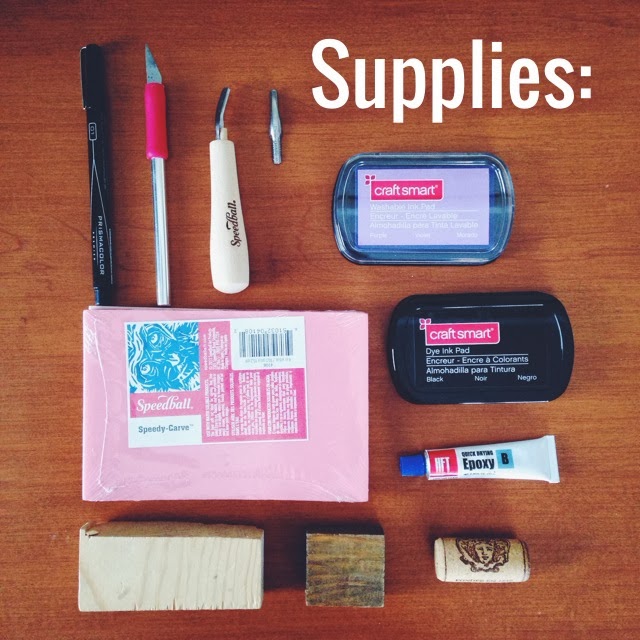
Your supplies:
- Pen
- Exacto Knife
- Burens/Buren Tips
- Rubber
- Wood Blocks or Cork
- Wood Glue (The only glue I had available was Epoxy, which didn't work too well with the rubber)
- Ink
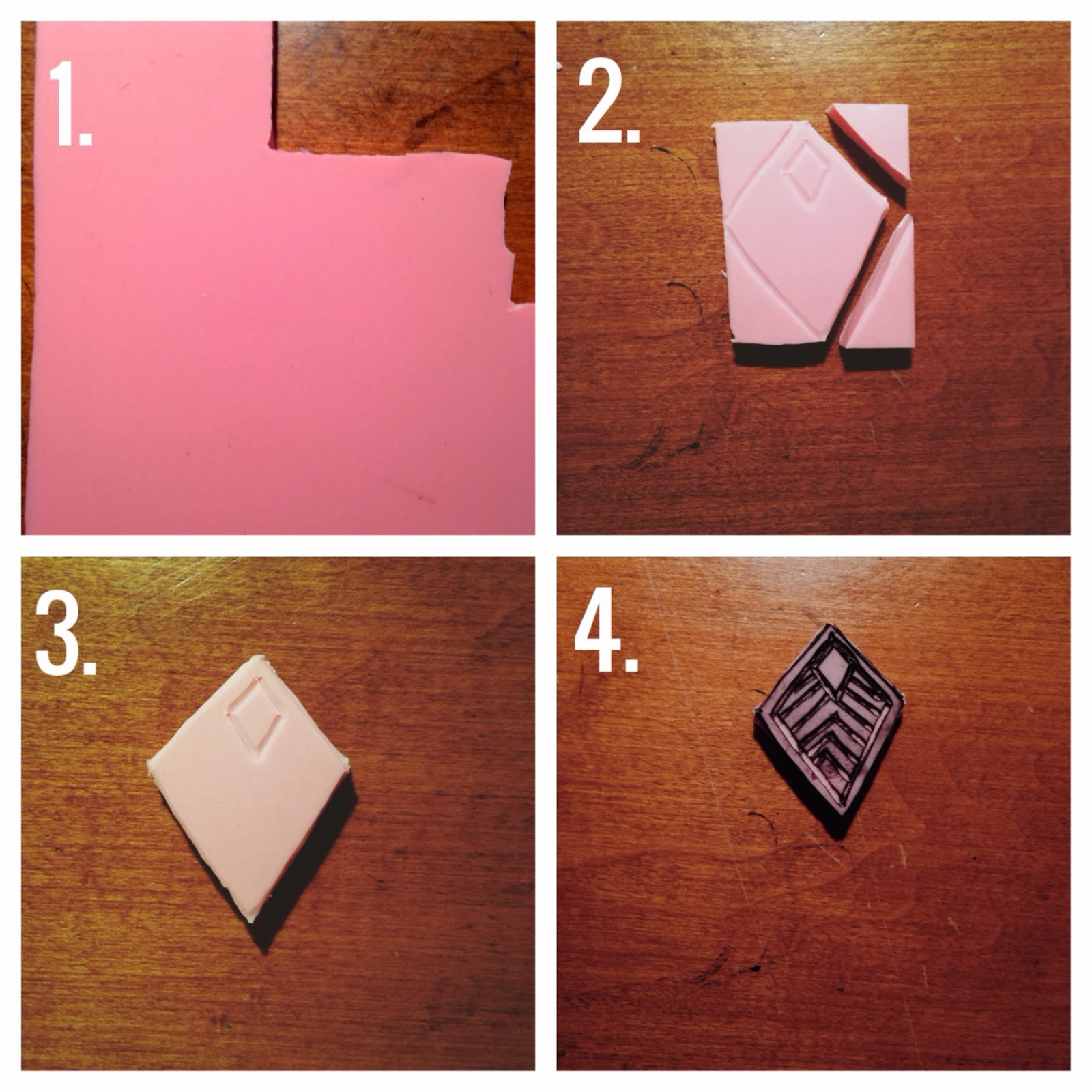
I decided to loosely base (and simplify) my stamp off of this vintage print.
This is a 1920s-inspired 1960s-made blouse available on Etsy that I think is pretty
adorable!
Next up you will want to pick out a woodblock or cork that matches the size of your design and use your wood glue to attach it to the back. This saves you from getting ink all over your hands when you dip the stamp into ink!
And you're done! I hope this tutorial was helpful and you feel inspired to create your own vintage inspired stamps. They're great for making art, cards, or adding personal touches to just about anything!
Tip: Use the edges you cut off from your main design as more stamps! I loved incorporating these mismatching triangles into designs.
Okay... I may have had way too much fun making stamps. Here are a few more examples I made - they're so easy!
Ellen
Subscribe to:
Posts (Atom)


.jpg)