Showing posts with label vintage fashion. Show all posts

Sunday, February 16, 2014

Favorite Fabrics: Osnaburg

Do you have a favorite fabric type? It could be a sturdy twill, an airy charmeuse, or a crisp voile... or if could even be one of those in-between fabrics, whose name you're uncertain of. You know, that special fabric you picked up that sits in your stash, waiting patiently for the day that you shout "Eureka!" and run to the sewing machine with a genius idea appropriate only for it.

I have several fabrics that I just love; some are officially named varieties, and some are those vague treasures. One of my absolute favorites to play with, however, is Osnaburg!


Osnaburg is a utilitarian fabric that may conjure images of work aprons and early peasant clothing, and with good reason! It was originally made from rough flax and jute, and it is a course, natural fabric perfect for the grungy grimy needs of all factory workers! Nowadays it is made primarily from cotton, but because it is still woven of a coursely spun, slubby fibers, spaced widely in their reed, it still retains the same aesthetic that it had when made from the original fibers.

The name "Osnaburg" comes from "Osnabrück", which is the name of the German city (though it's technically part of Saxony, culturally speaking). The fabric was originally made in Germany, but by the 18th century it had become a staple in the Scottish textile mills and was sold as a low-lint utility fabric used for facings, course under garments and lower class clothing (think factory workers and work-house prisoners). It was also used in The States to make the primary clothes of slave workers, due to it's sturdy and low-maintenance nature.

While bumbling around the internet the other day, searching for linen sources, I happened across a wonderful blog post at The Split Stitch, discussing the use of osnaburg as a linen alternative. I've been doing this for years, and this is probably the main reason I love osnaburg so much (it runs roughly $4 a yard, instead of linen's $15 a yard!) but I thought I'd share the post since it was very well written.

I use osnaburg for lightweight canvas bags, and it makes a great course medium for block printing. It would also make an excellent fabric for aprons, dish towels and even pillow covers. Because of its linen-look and soft hand, it also makes great skirts and it takes dye well (assuming you pre-wash well enough to get the factory goo out of it!)

I'm currently designing a new pattern that I intend to mock up using some of my osnaburg stash, so I'll be sure to post the finished results when I have them!

Have you ever used Osnaburg for anything? Do you have a fabric you prefer to work with?

Thursday, February 13, 2014

Vintage Color Palettes: 1916 Winter/Spring Fashion

Hi there! Emily, again. 

This is the second post in a series of entries showcasing some of the color palettes I use when I am designing/daydreaming. It's fascinating to look at a series of images from the same year and see the similarities in colors.


This set comes from 1916, smack dab in the middle of WWI. You can see that, other than the fashion couture dresses on the ends, many of these dresses are all considerably more simplistic in their trimming than the entry I posted from post-war 1919. The dominant colors in many of the dresses I found from 1916 were blues and pale apricots, as I've depicted below.

The dresses on either end of the graphic are both designed by "Lucile", an English designer of high fashion also known as Lady Duff-Gordon. She is known for developing the "fashion parade" or a sort of early fashion show, and her highly trimmed dresses are really a sight to behold, even just via computer. (She also survived the Titanic sinking, and was booked for the MS Lusitania on its last, disastrous trip as well, but cancelled due to illness! Yikes!)


Be sure to check back soon for more vintage color palettes, as well as all sorts of fun here at Seven Magpies!

Wednesday, January 29, 2014

Vintage Color Palettes: 1919 Silk Dresses

Hi there! Emily, here. 

I'm going to be posting a series of entries with some of the color palettes I use when I am designing/daydreaming. It's fascinating to look at a series of images from the same year and see the similarities in colors. Below is a set of colors I found repeatedly popping up in the dresses I found from 1919.

This was the time right after the end of WWI where women were able to indulge again, though in different ways. Heavily trimmed dresses were again in style and available, and light, airy fabrics like silk were available in all of the soft, effeminate, impractical colors of non-wartime. I love the use of champagnes and sages, and you can see by the snippets I've included of the original dresses that there was a renewed attention to detail in these beautiful gowns. 


I hope you enjoy this palette as much as I enjoyed researching and making it! I use these a lot when I am looking at fabric to order online. It helps keep me in the right family of colors so I don't buy anything that's too over-the-top. I've made plenty more of these palettes from nearly every era, and I'm sure they'll pop up somewhere in my future posts.

Do you refer to old photos or fashion plates for design help?

Sunday, January 26, 2014

Crafting: Make your own Dress Form

We all have that one thing in our dream crafting supplies that we'd love to make a reality, right? For me that's been a dress form. I love to draft patterns, and most of the time I use traditional slopers and blocks, but when it comes to finished tailoring of a piece I can't help but wish there was another "me" present so that I could really get the adjustments that I want.


Yesterday, my husband I made another "me"! (Pardon the "mussed" look. I've been moving things all over the place and haven't ironed my blouse muslin since...)

I've been eyeing tutorials on duck tape dress forms for a long time, but I remember a couple of classmates in college who tried it and had a miserable time. They ended up scrapping the idea, several dollars less-rich and several hours of frustration later. Being mildly claustrophobic, I always figured that between their observed failures and my nerves it just wasn't an option for me.

A certain amount of "zen desperation" (as I've taken to calling it) can transform a lady, though! The itch to have a dress form became a raging need this week, when I sketched up a blouse design that I am incredibly excited about. This pattern will require a drapey, semi-sheer fabric (pure silk, in my case - yay!) and will be a very challenging design to draft, as it uses carefully placed gathers to form-fit, rather than darts. Gathers are all fine and dandy until you realize that it's nearly impossible to get them just-so without, well... another "you".

I spent a few hours reading every single duck tape dress form tutorial that I could find and took lots of notes. I specifically looked for complaints, boasts, methods and results from each tutorial I read and after a while I began to feel more comfortable with the whole idea.

So last night, armed with two plastic garbage bags and three rolls of duct tape, my husband and I went to work. I felt prepared, both mentally and emotionally. However... The one thing I didn't remember to do was take lots of photographs! I don't know if it was the fact that I was being taped up in a plastic mummy-esque cocoon of anxiety, or if it was some deep-rooted desire to not have photographs taken of me while I was in such a vulnerable state, but I didn't take a damned one. *facepalm*

So, I will provide you with links to two of the amazing tutorials that I read, as well as the few snapshots I took toward the end of the process... As for the rest, I shall paint for you, with words. I've included all of the tips that I've collected, as well as the seriously awesome filling that I used that really helped me shape my dress form exactly the way I wanted. 


First, the tutorials that have more pictures than I do!:

The tutorial I started with was from Natasha over at "Little Pink Monster" since she mentioned that she used plastic wrap, instead of a t-shirt, for her dress form. I was definitely intrigued by this, as I had read (ages ago) that using a t-shirt was giving some people a very bulky result. Of course, wearing plastic wrap isn't for everyone, and since I didn't feel like using all of our plastic wrap I opted for a garbage bag. Little Pink Monster also had a list of things she felt she did wrong on her first attempt, which was SUPER helpful. She mentioned that on her first try, they used long pieces of tape which folded and added bulk in a few rather unflattering places. She also talked about how the dress footprint form became much more round rather than oval, when it was being stuffed. The filling I used to stuff my dress form solved this problem, big time!

The other tutorial that I really enjoyed was from Sarah over at "Offbeat Bride". She had very specific and helpful ways to start the duck tape layout in order to preserve bust shape and size ratios.

There was one other tutorial that I have unfortunately lost track of that offered the best advice I could possibly think of, despite not having followed it myself. This particular blogger had the foresight to cut most of her tape pieces ahead of time! She stuck them all over her house, and she and her partner then wandered around, taping her up as they went. The most time consuming part of this is the cutting of tape, so I can imagine this cut down on her "mummified" state by considerable minutes. I definitely should've done this!


And Now, my own method/madness:


FIRST: I made a wearable plastic garbage bag by cutting the corners and a small slit for my head to squeeze through. I wore the best bra I own, to make sure I was well shaped and supported. The garbage bag was a bit ridiculous, and very cold dressed like this in our 19th century cottage, but what's a girl to do?


SECOND: My husband began taping me up. We found that using a few long pieces to start with helped eliminate the excessive stretching that we were getting with the plastic bag. We did bands around my bust, waist, hips and shoulders, and were careful to fold the plastic bag as flat as possible under the tape.

THIRD: We did a supportive X around my bust (much like Offbeat Bride did) to keep it in an appropriate shape. My guess is that this is just as important if you are small chested as it is if you are large chested. You want the dress form to "form" to you, rather than squishing your bits this-way-n-that the way you might if you just started taping every which way.

FOURTH: We started using short pieces to patch all over, slowly but surely covering my entire bust/torso/hips. We were really careful to make sure the tape was really flat. One place that seemed to bulk up quickly was my waistline, and unfortunately I didn't notice this until it was too late. My dress form ended up roughly 2" bigger around than my waist, but knowing this I can take it into account and shore up the ease in the waist when I am tailoring something.

FIFTH: Once we had finished covering me in a layer of duck tape, we started again, but this time we applied the tape nearly perpendicular to the original layer to add strength. Anywhere the strips ran horizontally, we taped vertically for the second layer and vice versa. After roughly two and a half layers of tape, we were finished!

SIXTH: Jeremy took a permanent marker and marked important lines on the duck tape such as front center, back center, hips, natural waist, bust line, underarm line. All of those important things that you're supposed to concern yourself with if you draft your own patterns.

SEVENTH: Jeremy cut straight up the center back line that he had marked and I (thankfully) slipped out of my plastic mummy costume. I didn't realize how desperate and anxious I had gotten until he started cutting me out... suddenly I just couldn't wait for him to finish cutting. I may have gotten a bit testy. This was one of those special experiences that really requires an assistant that you are allowed to spaz out on a bit. 

EIGHTH: I ran a 6" wide piece of cardboard up the back of the split open dress form and used that to help me tape the split closed. Once I taped the split closed from top to bottom I cut out a circle for my neck hole and half-circles for my arm holes. I fit them into place and taped them lightly, assuming correctly that I would have to revisit them later to aid in stuffing the dress form.

This is mid-stuffing. The arms and thighs are kind of saggy looking since they aren't packed tightly enough yet. 

NINTH: I inserted the pole I was going to use to mount the dress form (in my case it was an old coat stand, but I've heard of people using IV stands, microphone stands, music stands, etc) and began stuffing the shell.


I used taxidermy pine straw which is like thin strings of pine, but you can use crumpled paper or wood shavings (not chips! the kind of fine wood shavings used in livestock pens). The thing I liked about the pine straw is that I could twist it and pack it into shapes that fit the areas inside the dress form. Also, once the form was nearly filled I could literally punch this stuff into place. If I had an area that was awkwardly shaped or slightly malformed I would just work at it for a moment and the pine straw shifted inside to pack more tightly in that area, eliminating the odd bulge here and there.

TENTH: Once I got the dress form stuffed – I mean really stuffed – I then over-stuffed the bottom and cut cardboard to fit it. I duck taped the cardboard on, cramming the overstuffing into the shell to give it a really firm feel. After this, I revisited the arm holes and neck and reworked the stuffing a bit, making sure the bust was evenly filled and very firm, and fleshing out the shoulder-blade area, which is an easy area to leave slightly hollowed. Once I was satisfied, I firmly taped the arm holes and neck hole closed and stepped back.

The contrast between the shiny and non shiny duck tapes makes her look a little lopsided, but she's perfect!

Of course I had to try it out immediately, so I pinned up a little 1940's yoked blouse that I have yet to put buttons on and it fit beautifully! You can see I have a little string attached to the top of her. This lets me hang the dress form if I need to, and it's attached simply by looping around one of the structural pieces of duck tape along the back of the neck.

WOWZA. There she is... a headless, armless, legless, duck tape ME!
I hope this has been marginally helpful for anyone who happens across it. I cannot praise the pine straw enough. I was able to manipulate it in ways I am sure I wouldn't have been able to, other fillings. 

It's tradition to name your dress form, and I just haven't quite got a name for this lady yet! I'm sure I'll come up with something soon, though. She can't stay nameless forever! 

Be sure to check in next week when I'll be posting about using a similar method to create a hat form for draping pieced hats!

Also, I'll be posting a tutorial on how best to cover your duck tape dress form as soon as I get around to taking some photos!

Do you use a dress form when sewing clothing? Did you build your own dress form, or do you use a conventional one? (No judgements here! I'm a big fan of the conventional ones!)

xoxo Emily 

Saturday, January 25, 2014

Ellen's Vintage Fashion Inspiration for 2014

Just like Emily mentioned in her fashion inspiration post, every year around this time I get incredibly antsy for new projects, inspiration, and new fashion! Today I'm going to share with you some of my favorite pieces, looks, and styles that will certainly inspire me for the year to come.

This is a 1922 House of Lanvin French dress housed in the Met's Fashion Collection. And I am in love. The combination of contrasting fabrics and colors is the first thing that catches my eye. It looks soft and comfortable, but still airy enough (especially with the coral cut outs) to be the perfect dress for a warm summer day! I love how the coral lines the neck and arm and creates a fun, geometric pattern to define the rest of the dress.

The cut of this dress is great too - and in fairly typical 1920s tradition. It looks loose enough to be incredibly comfortable, but still with a little definition around the waist and bust. And I can't get over that full skirt, either! Unfortunately this is the only photograph available on the Met's website, but I would absolutely love to get a closer look at the front of this piece (and not to mention all the detail!).


Another dress I have been fawning over lately is this beautiful silk 1930s dress that is available for sale on Etsy. I think the cut of this dress has to be my favorite part - the fit and flare is incredibly flattering. The pleating above the bust is an excellent addition as well, it adds just the right amount of visual interest to the top of the dress. 

There isn't too much information available on this dress. It's made of a slubbed silk which makes it fairly light and comfortable - and brings out the brilliant red coloring! This dress would be incredibly easy to add into a modern wardrobe as well. It's a style that is copied quite often, but I think it is executed to a T here!


Here we have a pair of 1930s metallic gold dancing shoes (also available on Etsy!). If only my feet were a little smaller they would be mine! Unfortunately, I don't know exactly when in the 30s these were made and worn (I'm not as much of a modern history expert as Emily is!), but they sure are adorable.

They have just the right amount of heel and hold your foot in well enough to look amazingly comfortable. But I love the metallic details and the woven cage around the toes! It's a different approach to the usually closed toe t-strap heel that I feel works really well.

I could just imagine having a fantastic time dancing in these, they are definitely going to be my inspiration while I am looking to buy new heels this season!

Lastly is this robin's egg blue, fur trimmed coat from the 1960s (that is also for sale!). I don't even know where to start with this dress! It's a wool blend with genuine fur cuffs and collar and the most adorable purple buttons. I love the lining along the front and can only imagine it to be a very flattering (and warm!) coat when it is worn.

I think the color of this coat is what really gets me! I think the powder blue mixed with the light purple buttons and light grey fur that has some dark highlights is the perfect mix of pastel and darker natural fur colors.

Although coats are a hard thing to copy, this is definitely my go-to for inspiration. I try to look for jackets in eye-catching colors with nice details without forgetting the warmth factor! This coat hits all those marks and I am incredibly jealous of whomever snatches it up!

I hope you've enjoyed taking a look at some of my vintage fashion inspiration - and that it may have inspired you! Do we share any of the same tastes?

Ellen

Thursday, January 23, 2014

Quote of the Day: How Lucille Ball's Sage Advice Saved the Day at Tea Time!

Do you ever feel a little stuck when working on a project? It reminds me of trying to get a car up a slippery hill in winter (something I've gained major experience points in, this year!) You have an abstract sense of what you want the final result to be, and you can clearly see where you are right now, but the path to the final result feels like it is working against you. You make a little progress, and erase it. Make a little progress and throw out your sketch, start over, toss a crumpled paper across the room in the general direction of the garbage bin. 


Yesterday I was stuck on a group of designs I thought I had firmly in my brain. I'd set a goal for the day and was staring at it – scrawled sloppily on a scrap of paper and tacked crookedly to the wall in front of my face. 

I kept sketching the same darned thing, over and over. Yes, brain, I've already got the pattern for that one drafted and nearly finished. No, brain, it doesn't count if you just put a different sleeve length on it. Go home, brain, you're tired. Wait, we are home. Drat.

I decided to take a break to grab a cup of tea (Herbal "Sweet and Spicy") and a graham cracker and it wasn't until I sat down that I noticed the quote on my tea bag.


"I'd rather regret the things I've done than regret the things I haven't done" – Lucille Ball

How perfect was that? In my moment of feeling droll, ordinary and unoriginal, there was Ms Ball, telling me to just let go and try some new things. I grabbed my pencil and began sketching out some designs based on drapier fabric, thinking about cowls and capelets and how they lay across the shoulders. I'd been focusing on designs using fabric that is easier for the average sewer, when all along my brain was trying to get me to say "Damn the average sewer! I want to challenge the average sewer and to make something truly elegant!" 

This quote was the four-wheel drive to my slippery slope, and I quickly met my goal and started drafting the pattern for this dress: 


I'm daydreaming of drapey rayon crepes and a gorgeous forties broach at the collar. I've also got some sketches of possible panel insertion and trimming for this one. We'll see! 

Have you ever found that perfect alignment of words that helps you forge ahead on a difficult task?

Thanks, Lucy!

xoxo Emily

Thursday, January 16, 2014

Style: Vintage Scarves and Seven Historical Ways to Wear Them

Today I am so very excited to share a post on vintage scarves with you! Scarves (both vintage and modern) are one of my favorite accessories, and I have an embarrassingly large collection.

Here is a little preview of just the vintage scarves I have in my collection. These mostly range from the 50s-70s. As you can tell, the majority of the scarves are silk and they are mostly all in little squares. I absolutely adore the range in patterns and the incredibly vibrant colors! The reds, yellows, greens, and oranges are eye-catchingly bright, plus they bring a ton of visual interest into whatever outfit they're paired with. The scarves with more traditional floral motifs even stray from that with their variety and color. Not to mention the geometric prints! The boldness of these prints make them a perfect addition to any outfit!


Now that I'm done blabbering about myself, here are seven ways to fashion scarves as seen in some of my favorite vintage eras!


1. The 1915 Front Knot:

This one is fairly simple: wrap your scarf under a collar and knot it in front of your blouse. This style comes from a brochure dating to 1915 that depicts a typical outfit for a female tennis player. I adore how her scarf ties under her collar and adds just the right amount of extra detail to her simple outfit!


2. The 1920s Head Wrap:

Fold your scarf into a triangle and then fold flat to your desired width. Wrap it around your head with both of your ends meeting under an ear and tie loosely! This is definitely a fairly scandalous image for the 1920s and unfortunately (even after 40 minutes of super internet sleuthing!) I couldn't find a solid source. I think this would look particularly nice with some sort of up do as is pictured, and is definitely a trend we don't see often enough!


This look simply requires a brooch (or hair pin!) to tie your scarf under your neck. It's a great way to bring in two different personal touches and add some color to your outfit! This photograph is showing a handmade crocheted scarf from an instructional booklet.


4. The 1937 Bow:

Pictured is Jean Muir with her scarf simply tied around her neck. The choice to spread out the extra scarf over her shoulders (rather than in front of her blouse) almost makes it resemble a bow! This scarf style is fantastic and is something I haven't seen before. This is a promotional photograph of Jean Muir published by First National Portrait (and it's for sale on eBay!).

5. The 1943 Rosie the Riveter:

Here is an example of the "Rosie the Riveter" (or Wendy the Welder!) scarf look. This one is also pretty simple: First fold your scarf into a triangle. Then wrap it around your head and over your ears and knot it a few inches back from your forehead. After you knot the scarf, pull the remaining triangle point under the knot and wrap it around - tucking it under so it stays in place! This is a classic way to keep hair out of your face while you're working and represents an important time for women!


6. The 1955 Sleep Cap:
I've included this sleep cap (as modeled by the one and only Lucille Ball) to show a variation in the "Rosie the Riveter" head scarf style (even though the sleep cap has been around for longer than the Rosie head scarf!). Here, Lucy has pushed the scarf behind her ears and knotted it about halfway back on her head with a little bow in order to show off her hairstyle!


7. The 1960s Jackie O:

Jackie Kennedy has taken the simple and turned it iconic. Simply fold your scarf into a triangle and wrap over your head, tying it loosely under your chin! This look is perfect for a windy fall day or just looking super fly in your convertible (I wish!).


I hope some of these ideas inspire you to play with your vintage scarves a bit differently than we usually see! Do you have any other styling tips for vintage scarves?

Ellen

Monday, January 13, 2014

Vintage Patterns from Tanglewood: The 1930s Briony Blouse


Hello folks! Emily, here.

Slowly but surely, over the past couple of years, I have been working on developing a small vintage pattern line. I think I might just be ready to release my first set this spring (fingers crossed!) so stay tuned!

I've been self drafting patterns in one way or another since I learned to sew. In middle school and much of high school I drafted costumes for the local renaissance festival and made several outfits for myself and for friends. I'll never live down the time I left a dress pin in the hem of a skirt I made for my friend, Amy... I'm pretty sure she sat on it in the middle of class. Hahaha.
When I got to college I thought I was going to get a degree in Art Ed with my focus at the time being photography, but all it took was a single accidental wander past the textile design studio and I knew where I belonged. Experimenting in that studio (and having bought bolts upon bolts of plain cotton muslin to fiddle about with) allowed me to learn all sorts of things about fitting and drafting clothing. I never got as much into couture design as I would have liked, but it was the community of knowledgable people in that department that really got me hooked on fiber and sewing.

I have three blouses and a dress mocked up and finished, with very satisfactory results. I'm still working on two other dresses and a skirt, but they're the kind of unfinished project that I pick away at over months so who knows when they'll be finished. This has been an interesting learning experience for me thus far because I am a fairly busty lady and I am aiming to find and draft patterns that work for both busty and not-so-busty ladies.

I thought today I'd like to give you all a sneak-preview of what I got accomplished this weekend. This is the third self-drafted pattern that I have then digitized. It is based originally on an early 1930s top I found at a flea market last year but with some slight changes to cut and fit to accommodate fabrics other than the gorgeous silk crepe de chine ($$$) that it was originally made in.
This is by far my most complicated pattern and I am looking for 1-2 more pattern testers, sizes 2-10, to try it out. If you're interested, please comment below! If I get enough interest, I'll probably be willing to expand my pattern trials a little so let me know!

This dainty blouse is airy and light, with a slight hint at late 20s androgyny and a sharp nautical-styled collar that plunges deep while remaining close to the skin so it is almost to the point of showing off a bit of vintage cleavage but remains period and simply alludes to its presence rather than showing it off. ;)

I'd really like to take a moment here to apologize for the terrible instagram photos I have posted of this blouse. The weather here in Michigan has been fairly atrocious, and there is nothing but poor lighting this time of year (both inside and out) so, until we get some seriously gorgeous weather you'll all just have to accept these silly, cliche selfies as examples of the Briony blouse.

The blouse that I am wearing in the photos is a size six, but the next one that I construct for myself will likely be a size eight to fit me a little more historically correctly. The sleeves are cuffed dolman, and the front inset is self-lined. It's made here in a lightweight cotton chambray, and I trimmed it with some black antique cotton lace that I had in my stash from the 1910s (I am a serious sucker for vintage notions!) This shirt works great untucked so you can see the trimmed bottom cuff for a relaxed 1930s look, or you can tuck it into your high-waisted slacks or skirt for a more formal appearance. It's a very versatile top!

...Gosh I'm really hating these photos, now. I can't wait until we get a chance to do some actual photos for this!


Tuesday, January 7, 2014

Vintage Style: My Fashionable Family in Hats

I have so many family photos that I am just dying to share with you all. The people in my old family photos certainly seem fashionably keen, so much so that I don't know if it was just a reflection of the times or if it was really just that I have some seriously hip ancestry.

This first photo I want to share with you today appears to be from the mid 1910's. You see it has examples of some of the typical Edwardian formality and yet you don't yet see the practical changes that came about after the first world war (did I mention I'm a history geek?). Still, I'm inclined to say this is approaching (or even early) wartime because of the shorter skirts and lower, slightly more practical shoes, as well as the large pockets.

To be honest, a lot of my knowledge of clothing history is more British-based, and I'm still learning about the early 20th century American styles. My family was almost certainly already in North America by this time, though I don't really know who these women are. I'll have to ask my mother. :)

The thing I love about these old photos is that everybody appears to always wear hats, out of doors. The first photo is a great example of the silhouette of the Edwardian hat, while this next one shows the changes in silhouette to a more sleek cloche form. The hat material is also different, where a few of the earlier hats appear to be straw or lightweight fabric, the bottom shows a much heavier woolen-type hat.

Now this photo really makes me smile...

These ladies are posed next to a beautiful automobile (does anyone know the car make? There's a logo but I can't quite make it out...) with a 1930 license plate. In both photos, you can see that the elder women are dressed more conservatively while the younger women wear lighter colors and more modern cuts. In addition to the great cloche hats in this photo, make sure you take a peek at those shoes! I'm a sucker for 1920's cutout and t-strap shoes, and the pair on the right just makes me squirm with envy.


I've got plenty more where these come from, and I'm sure I'll be sharing them as we roll along here at Seven Magpies.

Do you have old family photos? What era are your favorites from?  

Thursday, January 2, 2014

Emily's Vintage Fashion Inspiration for 2014

It's exciting to think of the new year as a clean slate for DIY projects, whether they involve new skills or old, whether they're challenging or simple. This is the season for planning and scheming and I'm so happy it's finally come! Of course, when we get to the winter doldrums in four weeks or so I'll be whining and crying about how I can't take the winter weather anymore, but I guess Michigan is like that...

So here is a sampling of the vintage fashion that I've been drooling over recently:


 To the right here is a dress that is listed as being from 1918, though I have to admit I'm kind of skeptical of the dating on it. It really seems to be later than that. Still, it's listed by a seemingly reputable vintage dealer in Chicago, so maybe they really do know their stuff.  
Anyway, I love the large, bold front plaiting, made more delicate by the embroidery and bead patterned trim. The small pleats along the bust are awesome too, especially with the texture of the silk. It's a dress that you know would cling to all of the right places, alluding to form and shape without revealing anything too daring.  
There is very little detail about this dress on the web site where I found it, but the delicate, relaxed-looking lines and starchy, intricate details are enough to make me want to draft a pattern inspired by it. Now I've just got to find a nice source for silk that isn't in terrible, gaudy colors!


This next one is a woolen day dress from 1924, designed by Chanel and I'm pretty sure it's from the Metropolitan Museum of Art's collection (Ya know, that seriously amazing fashion collection that they keep hiding in some dark secret place? That one.)
I'm having a hard time finding much information about this dress as well, but I almost wonder if it's a wool knit, based on the way that it drapes. I love the covered buttons and the chain detail. This is a great example of a mid twenties dress that might actually work for someone a bit bustier than the typical female silhouette of the era.
The piecing on this one is also very curious, and the diagonal lines seem like they would be flattering to a curvier lady. I can just picture this one with a pair of buffed brown oxfords, a set of pearls and a sage green cloche hat!


 This third photo is a period photo from 1942 of two members of the Women's Land Army, specifically the New South Wales division in Australia. The Women's Land Army, or WLA, was a division of the National Service and was a volunteer organization. The women of the WLA were responsible for much of the agriculture during the second World War. 
So anyway, this photo shows some great vintage overalls, or dungarees, and I am just dying to make myself a pair to throw on in the morning for farm chores. Theirs are most certainly army issued, so there wasn't much variation in them. I am currently drafting a pattern that allows for a thick cotton flannel lining and if they work well I may eventually do a pair lined in wool for the coldest of our Michigan months.  
I am constantly finding myself inspired by the women of the Land Army, as well as the thrifty utilitarian fashion of war-time. War brings about a sort of practicality in fashion that seriously stirs me.  


Finally I wanted to end with something a little less predictable. This dress is supposedly straight from the 1940's, though it's another one that I suspect is a bit later than the original poster has said. There is something so classically utopian/dystopian about this dress's design that reminds me of the aesthetic of older sci-fi movies like Blade Runner, and Dark City (and maybe even a bit of City of Ember). 
I love the seemingly pointless detail around the collar, and there is another tab with a strip of non-functional buttons down the back. It's so starkly contrasting against the utilitarian and somewhat stuffy, conservative cut of the dress. 

This just begs to be drafted and remade in a slubby neutral wool with some sort of wild button color (and maybe contrasting stitching or embroidery?) The possibilities are endless! 


Have you been seriously inspired by anything lately? Do you have any big projects planned for the new year? Thanks for checking in!
- Emily 


Saturday, December 28, 2013

Vintage Style: Inspiration and a 1950s Dress

 I feel like I've mentioned my grandmother in just about every post so far, but what can I say. My grandma's style (both retro and currently) is a huge inspiration for me! This dress is from 1952 and I've heard that it's the dress that my grandma was wearing when my grandpa fell in love with her!

Everything about this dress is my favorite part. The blues and greens are incredibly bright and eye catching; the pattern is flattering and carefully detailed; the slight rouching on the neckline is the perfect touch (and holds the dress up nicely); and the cut is similar to a fit and flare without a noticeable flare. One of the best parts of the dress is the quality. The pleating (although barely visible here) lets the dress out subtly and makes a huge difference while you're wearing it. There has been very close attention paid to the cut, stitching and thickness of the dress - clearly enough that it has survived in perfect quality for over sixty years! It's these kinds of touches that make vintage dresses the perfect staple in anyone's wardrobe.

I paired this dress with some other classic staples. My necklace is made of thick pearls and is one long (twenties style!) strand that I wrapped around my neck a few times. This matches my hidden pearl earrings and t-strap heels. The vintage inspired t-straps are my go to heel for any slightly formal or very formal occasion and add a vintage-y flair to anything they're paired with.
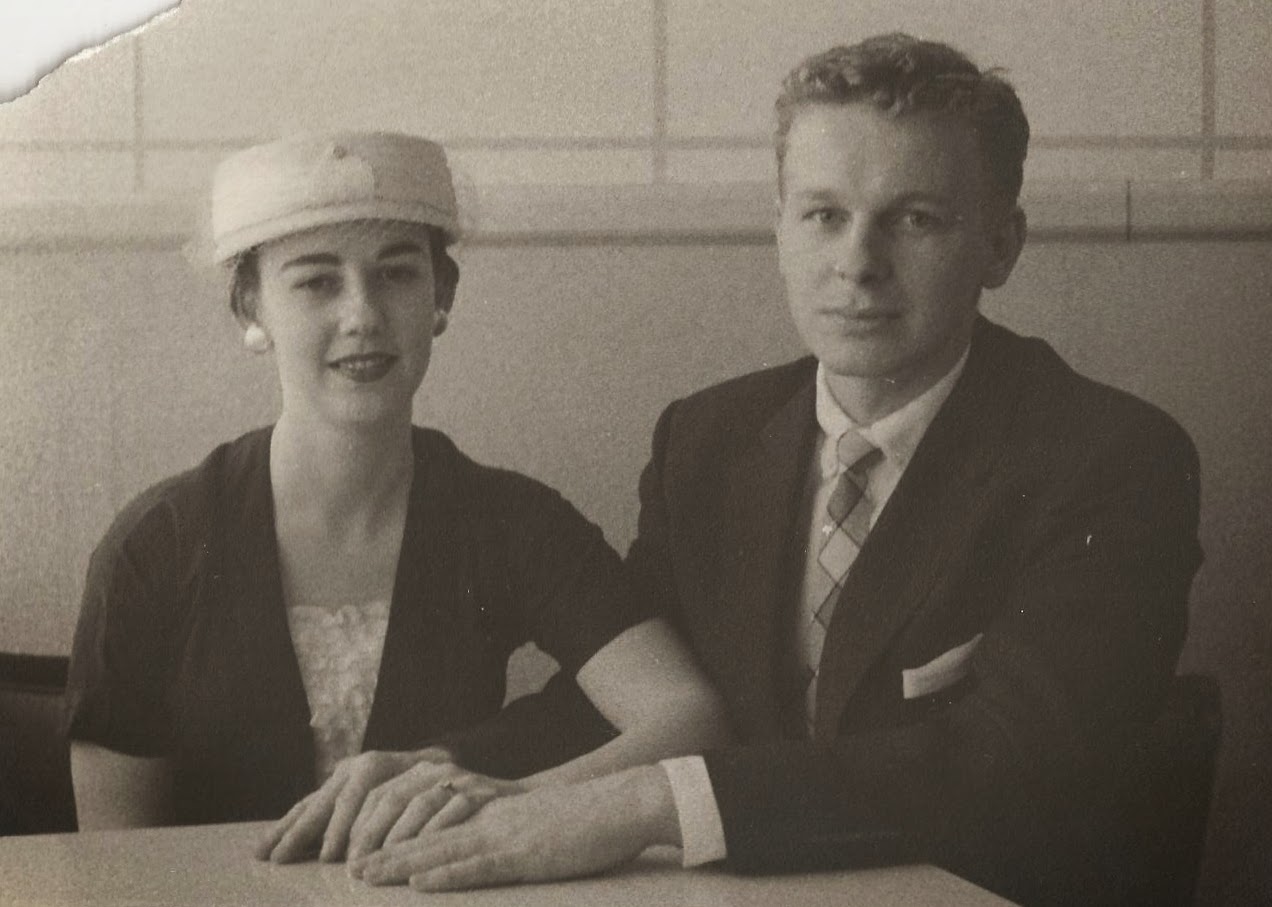
I can picture my grandmother (and ladies in dresses alike) attending parties and weddings in this dress and having a ball on the dance floor! This got me thinking about vintage formal attire, and I remembered a photo my mom recently found.

Here is a great photograph of my grandma and grandpa at a wedding just before they got married, so most likely around 1954 or 1955. As you can see, I got pretty lucky with my gene pool! My grandma is wearing a chunky pair of clip on earrings and a beautiful pillbox hat to go with her short sleeved jacket and ruffled dress top. And let's not forget about the fantastic diamond color block tie donned by my grandpa! 
These two set the bar pretty high and are the perfect pair for my vintage inspiration - who do you get your vintage inspiration from?

Ellen


Thursday, December 26, 2013

Work In Progress: Early 20th century Skating Skirt

Emily, here!

A week ago I was invited to attend an even called "Holiday Nights" at Greenfield Village, the open-air living history museum adjacent to the Henry Ford Museum. Holiday Nights is an amazing adventure into the past. The Village itself is an amalgam of historical buildings and "places", all arranged neatly along streets to provide a literal walk through history. There are houses and workshops, and even a factory originally owned by Thomas Edison, seated comfortably next to his workshops which you can tour.

If you're a history nerd like I am, this place is heaven! Holiday Nights is their wintertime celebration during which they offer live music in various settings around the village. You can snuggle next to a bonfire and listen to fife, crowd the foyer of a 19th century manor to hear hammered dulcimer and glockenspiel, follow the traveling carolers and more! There are "street vendors" selling roasted chestnuts, hot cocoa and warm cider, as well as lanterns and wreaths. It was so beautiful. Everywhere you looked were people carrying little lights and lanterns, and people were laughing and singing all around the village (except for one of the houses. One of the houses belonged to a very conservative family, whose religion I have forgotten, who did not observe Christmas...) and the end of the night was led by a parade of noise and lights to the town hall where all of the visitors caroled as fireworks were set off over the village lake. Holy cow. I haven't had good educational fun like that in a very long time.

SO.
I've had this idea for a vintage-inspired skirt tickling the back of my head ever since that night and over the past few days I've been able to really get some work done on it. I want desperately to make one of those warm woolen skirts that you see women wearing for figure skating both in the 1910's and again in the 40s.


Ideally I'd like it to be the kind of skirt that you can pair with a fancy muff or a muck fork, depending on where you are! The biggest challenge for me was definitely coming up with something that is practical as well as elegant.

I spent an entire day pouring over my vintage/antique patterns (and Pinterest, of course) in order to come up with just the right cut. Finally I settled on one of my favorite patterns from "Past Patterns" which is a 1915, six gored skirt with a sort of "yoke belt". I used this patter as my base and altered it slightly to give it a slightly more 40's silhouette and length, and unless I'm sorely mistaken the result is going to be spectacular!

This pattern is a perfect example of how to find yourself in over your head with antique sewing! The pattern has a scant 4 lines of directions and was originally unprinted, leaving a series of perforations to be carefully deciphered by the seamstress or tailor. The "yoke belt" is nearly impossible to figure out, and in the end I decided to wing it. It was only after I finished the top of the skirt that I figured out how I should've done it, as it ended up a bit bulky, but it still looks fantastic when it's on!

The fabric that I had the pleasure of using for this was a heavy Italian wool. Don't get me wrong, I'm really not the kind of gal to go and splurge on some over-the-top luxury fabric, but last year I visited the Fabric Warehouse over in Warren, Michigan and stumbled across this amazing fabric for $12.99 a yard, when it had originally sold for $50-60 a yard in New York City fashion houses. Holy Moly, right? It's the most luxurious fabric I've ever sewn with (though I have a couple of other gems in my collection waiting to be used) so there was a lot of pressure to make it into something special. This project has proved to be the perfect excuse.

I have yet to add the buttons, hook-and-eyes and hem (which I am just realizing I've never actually done an invisible hem – maybe I can get away with hiding a plain-stitched hem in an embellishment at the bottom as pictured on the drawing...) so there will be plenty of photos of this babe when I'm finished. I'll be finishing the hem at a shorter length than was typical of the Edwardian period from which this pattern comes simply because I want it to be a working skirt, or the kind of skirt that you'd wear when skating on the local pond. It needs to be short enough that my wellies don't get caught up in it as I'm trudging out to feed the livestock, but ideally it should be long enough to allude to the modesty of the era.

Stay tuned for more photos!

Sunday, December 22, 2013

Vintage Style Showcase: 1930s Florsheim "Florette" Pumps

Sometimes when I see a piece of vintage clothing my heart begins to pitter-patter like a child with a schoolgirl crush. These shoes are just such an item! When I saw them, I knew I had to add them to my collection of wearable vintage shoes.

The most exciting thing about these shoes (apart from their wearability) is that their original stamp is still fully visible inside. They are a late 1930's "Florette" shoe by Florsheim, and thanks to Google I was able to find the text from an original ad for them from The Salt Lake Tribune, April 1936! They were sold at a store in Salt Lake City called Auerbach's, and cost $8.75-9.75, depending on whether you wanted them in solid or strapped pumps.  Here's the original ad text:


 Hosiery—Street Floor "FLORETTE" SHOES By Florsheim if you're young or have young ideas 8.75-9.75 an d up "Florette" shoes have that out-of-the-ordinary smartness every chic young woman craves. If you have a practical side, too, remember they're FLORSHEIM and that means they'll wear. Expertly fitted by X-Ray Shoe Dept

And, while it is obviously likely they were purchased someplace other than Auerbach's, here is a period photo of the building that the above ad references:


Can't you just imagine the roar of 30's traffic, and the click of wooden heels on the pavement as you walked up to Auerbach's Department Store in 1936 to pick out your new pumps from the latest spring line? How exciting! 

The (American) Florsheim company was started at the end of the 19th century in Chicago, Illinois. You can find some more information about the company HERE at the historical Encyclopedia of Chicago website.

The company survived both World Wars rather well, which is fairly impressive, and I guess there was a big "to do" about the company moving to St. Louis in 1953 since they'd been such a staple in the Chicago area. Since my pair of Florsheims are definitely pre-1950s, it's safe to say they were manufactured in the heart of the Chicago factory works. If you click the small thumbnail on the left, it links to the Encyclopedia of Chicago zoomable image of the Florsheim factory in 1949.

The shoes are a soft, supple leather in a neutral warm fawn color, and have so many design details that it's hard to highlight them all. The most obvious of the details is the enameled metal flowers on the "tongue" of the shoe, with beautiful red and yellow glass. They are also a reasonably vague antiquated silhouette, with their pointed toes and scooping heels, so they fit with pretty much any of the fashions from the turn of the 20th century through the 1940's!

While these shoes are a bit narrow for the modern foot, they are still in a wearable size and I can't wait to take them for a spin once the weather clears up a bit!

Have you ever had that tingly giddy feeling about a vintage item? What was it for you?