Showing posts with label vintage clothing. Show all posts

Thursday, January 16, 2014

Style: Vintage Scarves and Seven Historical Ways to Wear Them

Today I am so very excited to share a post on vintage scarves with you! Scarves (both vintage and modern) are one of my favorite accessories, and I have an embarrassingly large collection.

Here is a little preview of just the vintage scarves I have in my collection. These mostly range from the 50s-70s. As you can tell, the majority of the scarves are silk and they are mostly all in little squares. I absolutely adore the range in patterns and the incredibly vibrant colors! The reds, yellows, greens, and oranges are eye-catchingly bright, plus they bring a ton of visual interest into whatever outfit they're paired with. The scarves with more traditional floral motifs even stray from that with their variety and color. Not to mention the geometric prints! The boldness of these prints make them a perfect addition to any outfit!


Now that I'm done blabbering about myself, here are seven ways to fashion scarves as seen in some of my favorite vintage eras!


1. The 1915 Front Knot:

This one is fairly simple: wrap your scarf under a collar and knot it in front of your blouse. This style comes from a brochure dating to 1915 that depicts a typical outfit for a female tennis player. I adore how her scarf ties under her collar and adds just the right amount of extra detail to her simple outfit!


2. The 1920s Head Wrap:

Fold your scarf into a triangle and then fold flat to your desired width. Wrap it around your head with both of your ends meeting under an ear and tie loosely! This is definitely a fairly scandalous image for the 1920s and unfortunately (even after 40 minutes of super internet sleuthing!) I couldn't find a solid source. I think this would look particularly nice with some sort of up do as is pictured, and is definitely a trend we don't see often enough!


This look simply requires a brooch (or hair pin!) to tie your scarf under your neck. It's a great way to bring in two different personal touches and add some color to your outfit! This photograph is showing a handmade crocheted scarf from an instructional booklet.


4. The 1937 Bow:

Pictured is Jean Muir with her scarf simply tied around her neck. The choice to spread out the extra scarf over her shoulders (rather than in front of her blouse) almost makes it resemble a bow! This scarf style is fantastic and is something I haven't seen before. This is a promotional photograph of Jean Muir published by First National Portrait (and it's for sale on eBay!).

5. The 1943 Rosie the Riveter:

Here is an example of the "Rosie the Riveter" (or Wendy the Welder!) scarf look. This one is also pretty simple: First fold your scarf into a triangle. Then wrap it around your head and over your ears and knot it a few inches back from your forehead. After you knot the scarf, pull the remaining triangle point under the knot and wrap it around - tucking it under so it stays in place! This is a classic way to keep hair out of your face while you're working and represents an important time for women!


6. The 1955 Sleep Cap:
I've included this sleep cap (as modeled by the one and only Lucille Ball) to show a variation in the "Rosie the Riveter" head scarf style (even though the sleep cap has been around for longer than the Rosie head scarf!). Here, Lucy has pushed the scarf behind her ears and knotted it about halfway back on her head with a little bow in order to show off her hairstyle!


7. The 1960s Jackie O:

Jackie Kennedy has taken the simple and turned it iconic. Simply fold your scarf into a triangle and wrap over your head, tying it loosely under your chin! This look is perfect for a windy fall day or just looking super fly in your convertible (I wish!).


I hope some of these ideas inspire you to play with your vintage scarves a bit differently than we usually see! Do you have any other styling tips for vintage scarves?

Ellen

Monday, January 13, 2014

Vintage Style Showcase: Scrumptious Late 1930's Scamparoos Oxfords

What's cuter than a pair of shiny vintage Oxfords with heavy detailing and original laces? Well, not much, that's for sure! These are "deadstock" shoes which means they were kept, unworn, until I purchased them. Their leather soles were unscuffed, their laces uncreased. They had little wrinkles on their tops as if someone may have tried them on, perhaps to walk across the carpeted shoe shop and back, but beyond that they were immaculate!

I had one heckuva time researching these shoes, so I'm hoping this blog post will help someone out some day, just in case there is another pair of Scamparoos out there. Apparently Scamparoos is a division of "Star Brand Shoes" which is nearly as obscure. Scamparoos appears to be their children's line of shoes, as the only pairs I can find (very few) are all sized in vintage children's sizing. Star Brand Shoes was originally a division of International Shoe Company which (it sounds like) simultaneously launched Poll Parrot shoes. It's all very confusing to read up on, since I'm gleaning information from old scanned newspaper articles and whatnot.

I've gleaned some really fascinating information through several snippets about Star Brand (often just image captions or bits of info on ebay auctions!) that in the 1940's, during the second World War, there was a leather shortage because Uncle Sam was buying all of the leather up for military use. During that time, Star Brand and Scamparoos Shoes were manufactured with wooden heels and/or molded rubber soles, despite their claim to only ever use leather.

After the war, they put out ads in several national news resources stating that they would offer a $5 reward, as well as complete re-soling to anyone who brought in their wartime inferiorly made Star Brand shoes. Isn't that cool? Companies really stood by their principles back then! :)

So anyway, these shoes in particular are a bit mysterious. They have leather soles, but with a molded rubber heel that has a label on it that is associated with military-wear. All I can imagine is that they were likely a young ladies' shoe designed for use in military offices and field. They are very practical, and incredibly well made. Despite being made with a utilitarian practicality, I just love the details on old oxford shoes from this era.

They're also the most comfortable shoe I own, and I own a lot of shoes! Between their comfort, aesthetic and mysterious backstory, these are my absolute favorite shoes!

 Do you have any footwear, new or old, that seems to have been made just for you?

Until next time, adieu!
xoxo Emily

Thursday, January 2, 2014

Emily's Vintage Fashion Inspiration for 2014

It's exciting to think of the new year as a clean slate for DIY projects, whether they involve new skills or old, whether they're challenging or simple. This is the season for planning and scheming and I'm so happy it's finally come! Of course, when we get to the winter doldrums in four weeks or so I'll be whining and crying about how I can't take the winter weather anymore, but I guess Michigan is like that...

So here is a sampling of the vintage fashion that I've been drooling over recently:


 To the right here is a dress that is listed as being from 1918, though I have to admit I'm kind of skeptical of the dating on it. It really seems to be later than that. Still, it's listed by a seemingly reputable vintage dealer in Chicago, so maybe they really do know their stuff.  
Anyway, I love the large, bold front plaiting, made more delicate by the embroidery and bead patterned trim. The small pleats along the bust are awesome too, especially with the texture of the silk. It's a dress that you know would cling to all of the right places, alluding to form and shape without revealing anything too daring.  
There is very little detail about this dress on the web site where I found it, but the delicate, relaxed-looking lines and starchy, intricate details are enough to make me want to draft a pattern inspired by it. Now I've just got to find a nice source for silk that isn't in terrible, gaudy colors!


This next one is a woolen day dress from 1924, designed by Chanel and I'm pretty sure it's from the Metropolitan Museum of Art's collection (Ya know, that seriously amazing fashion collection that they keep hiding in some dark secret place? That one.)
I'm having a hard time finding much information about this dress as well, but I almost wonder if it's a wool knit, based on the way that it drapes. I love the covered buttons and the chain detail. This is a great example of a mid twenties dress that might actually work for someone a bit bustier than the typical female silhouette of the era.
The piecing on this one is also very curious, and the diagonal lines seem like they would be flattering to a curvier lady. I can just picture this one with a pair of buffed brown oxfords, a set of pearls and a sage green cloche hat!


 This third photo is a period photo from 1942 of two members of the Women's Land Army, specifically the New South Wales division in Australia. The Women's Land Army, or WLA, was a division of the National Service and was a volunteer organization. The women of the WLA were responsible for much of the agriculture during the second World War. 
So anyway, this photo shows some great vintage overalls, or dungarees, and I am just dying to make myself a pair to throw on in the morning for farm chores. Theirs are most certainly army issued, so there wasn't much variation in them. I am currently drafting a pattern that allows for a thick cotton flannel lining and if they work well I may eventually do a pair lined in wool for the coldest of our Michigan months.  
I am constantly finding myself inspired by the women of the Land Army, as well as the thrifty utilitarian fashion of war-time. War brings about a sort of practicality in fashion that seriously stirs me.  


Finally I wanted to end with something a little less predictable. This dress is supposedly straight from the 1940's, though it's another one that I suspect is a bit later than the original poster has said. There is something so classically utopian/dystopian about this dress's design that reminds me of the aesthetic of older sci-fi movies like Blade Runner, and Dark City (and maybe even a bit of City of Ember). 
I love the seemingly pointless detail around the collar, and there is another tab with a strip of non-functional buttons down the back. It's so starkly contrasting against the utilitarian and somewhat stuffy, conservative cut of the dress. 

This just begs to be drafted and remade in a slubby neutral wool with some sort of wild button color (and maybe contrasting stitching or embroidery?) The possibilities are endless! 


Have you been seriously inspired by anything lately? Do you have any big projects planned for the new year? Thanks for checking in!
- Emily 


Saturday, December 28, 2013

Vintage Style: Inspiration and a 1950s Dress

 I feel like I've mentioned my grandmother in just about every post so far, but what can I say. My grandma's style (both retro and currently) is a huge inspiration for me! This dress is from 1952 and I've heard that it's the dress that my grandma was wearing when my grandpa fell in love with her!

Everything about this dress is my favorite part. The blues and greens are incredibly bright and eye catching; the pattern is flattering and carefully detailed; the slight rouching on the neckline is the perfect touch (and holds the dress up nicely); and the cut is similar to a fit and flare without a noticeable flare. One of the best parts of the dress is the quality. The pleating (although barely visible here) lets the dress out subtly and makes a huge difference while you're wearing it. There has been very close attention paid to the cut, stitching and thickness of the dress - clearly enough that it has survived in perfect quality for over sixty years! It's these kinds of touches that make vintage dresses the perfect staple in anyone's wardrobe.

I paired this dress with some other classic staples. My necklace is made of thick pearls and is one long (twenties style!) strand that I wrapped around my neck a few times. This matches my hidden pearl earrings and t-strap heels. The vintage inspired t-straps are my go to heel for any slightly formal or very formal occasion and add a vintage-y flair to anything they're paired with.
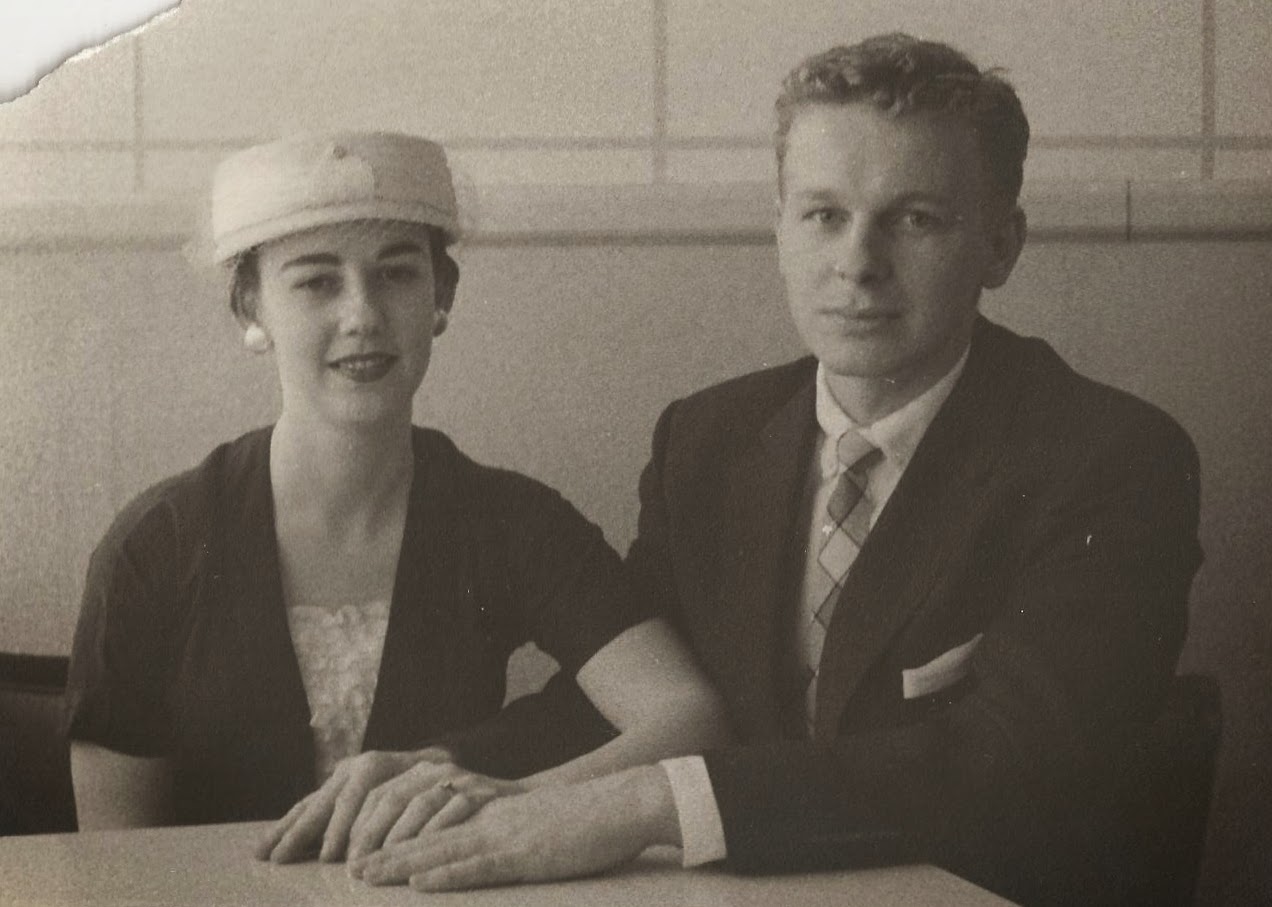
I can picture my grandmother (and ladies in dresses alike) attending parties and weddings in this dress and having a ball on the dance floor! This got me thinking about vintage formal attire, and I remembered a photo my mom recently found.

Here is a great photograph of my grandma and grandpa at a wedding just before they got married, so most likely around 1954 or 1955. As you can see, I got pretty lucky with my gene pool! My grandma is wearing a chunky pair of clip on earrings and a beautiful pillbox hat to go with her short sleeved jacket and ruffled dress top. And let's not forget about the fantastic diamond color block tie donned by my grandpa! 
These two set the bar pretty high and are the perfect pair for my vintage inspiration - who do you get your vintage inspiration from?

Ellen


Thursday, December 26, 2013

Work In Progress: Early 20th century Skating Skirt

Emily, here!

A week ago I was invited to attend an even called "Holiday Nights" at Greenfield Village, the open-air living history museum adjacent to the Henry Ford Museum. Holiday Nights is an amazing adventure into the past. The Village itself is an amalgam of historical buildings and "places", all arranged neatly along streets to provide a literal walk through history. There are houses and workshops, and even a factory originally owned by Thomas Edison, seated comfortably next to his workshops which you can tour.

If you're a history nerd like I am, this place is heaven! Holiday Nights is their wintertime celebration during which they offer live music in various settings around the village. You can snuggle next to a bonfire and listen to fife, crowd the foyer of a 19th century manor to hear hammered dulcimer and glockenspiel, follow the traveling carolers and more! There are "street vendors" selling roasted chestnuts, hot cocoa and warm cider, as well as lanterns and wreaths. It was so beautiful. Everywhere you looked were people carrying little lights and lanterns, and people were laughing and singing all around the village (except for one of the houses. One of the houses belonged to a very conservative family, whose religion I have forgotten, who did not observe Christmas...) and the end of the night was led by a parade of noise and lights to the town hall where all of the visitors caroled as fireworks were set off over the village lake. Holy cow. I haven't had good educational fun like that in a very long time.

SO.
I've had this idea for a vintage-inspired skirt tickling the back of my head ever since that night and over the past few days I've been able to really get some work done on it. I want desperately to make one of those warm woolen skirts that you see women wearing for figure skating both in the 1910's and again in the 40s.


Ideally I'd like it to be the kind of skirt that you can pair with a fancy muff or a muck fork, depending on where you are! The biggest challenge for me was definitely coming up with something that is practical as well as elegant.

I spent an entire day pouring over my vintage/antique patterns (and Pinterest, of course) in order to come up with just the right cut. Finally I settled on one of my favorite patterns from "Past Patterns" which is a 1915, six gored skirt with a sort of "yoke belt". I used this patter as my base and altered it slightly to give it a slightly more 40's silhouette and length, and unless I'm sorely mistaken the result is going to be spectacular!

This pattern is a perfect example of how to find yourself in over your head with antique sewing! The pattern has a scant 4 lines of directions and was originally unprinted, leaving a series of perforations to be carefully deciphered by the seamstress or tailor. The "yoke belt" is nearly impossible to figure out, and in the end I decided to wing it. It was only after I finished the top of the skirt that I figured out how I should've done it, as it ended up a bit bulky, but it still looks fantastic when it's on!

The fabric that I had the pleasure of using for this was a heavy Italian wool. Don't get me wrong, I'm really not the kind of gal to go and splurge on some over-the-top luxury fabric, but last year I visited the Fabric Warehouse over in Warren, Michigan and stumbled across this amazing fabric for $12.99 a yard, when it had originally sold for $50-60 a yard in New York City fashion houses. Holy Moly, right? It's the most luxurious fabric I've ever sewn with (though I have a couple of other gems in my collection waiting to be used) so there was a lot of pressure to make it into something special. This project has proved to be the perfect excuse.

I have yet to add the buttons, hook-and-eyes and hem (which I am just realizing I've never actually done an invisible hem – maybe I can get away with hiding a plain-stitched hem in an embellishment at the bottom as pictured on the drawing...) so there will be plenty of photos of this babe when I'm finished. I'll be finishing the hem at a shorter length than was typical of the Edwardian period from which this pattern comes simply because I want it to be a working skirt, or the kind of skirt that you'd wear when skating on the local pond. It needs to be short enough that my wellies don't get caught up in it as I'm trudging out to feed the livestock, but ideally it should be long enough to allude to the modesty of the era.

Stay tuned for more photos!

Sunday, December 22, 2013

Vintage Style Showcase: 1930s Florsheim "Florette" Pumps

Sometimes when I see a piece of vintage clothing my heart begins to pitter-patter like a child with a schoolgirl crush. These shoes are just such an item! When I saw them, I knew I had to add them to my collection of wearable vintage shoes.

The most exciting thing about these shoes (apart from their wearability) is that their original stamp is still fully visible inside. They are a late 1930's "Florette" shoe by Florsheim, and thanks to Google I was able to find the text from an original ad for them from The Salt Lake Tribune, April 1936! They were sold at a store in Salt Lake City called Auerbach's, and cost $8.75-9.75, depending on whether you wanted them in solid or strapped pumps.  Here's the original ad text:


 Hosiery—Street Floor "FLORETTE" SHOES By Florsheim if you're young or have young ideas 8.75-9.75 an d up "Florette" shoes have that out-of-the-ordinary smartness every chic young woman craves. If you have a practical side, too, remember they're FLORSHEIM and that means they'll wear. Expertly fitted by X-Ray Shoe Dept

And, while it is obviously likely they were purchased someplace other than Auerbach's, here is a period photo of the building that the above ad references:


Can't you just imagine the roar of 30's traffic, and the click of wooden heels on the pavement as you walked up to Auerbach's Department Store in 1936 to pick out your new pumps from the latest spring line? How exciting! 

The (American) Florsheim company was started at the end of the 19th century in Chicago, Illinois. You can find some more information about the company HERE at the historical Encyclopedia of Chicago website.

The company survived both World Wars rather well, which is fairly impressive, and I guess there was a big "to do" about the company moving to St. Louis in 1953 since they'd been such a staple in the Chicago area. Since my pair of Florsheims are definitely pre-1950s, it's safe to say they were manufactured in the heart of the Chicago factory works. If you click the small thumbnail on the left, it links to the Encyclopedia of Chicago zoomable image of the Florsheim factory in 1949.

The shoes are a soft, supple leather in a neutral warm fawn color, and have so many design details that it's hard to highlight them all. The most obvious of the details is the enameled metal flowers on the "tongue" of the shoe, with beautiful red and yellow glass. They are also a reasonably vague antiquated silhouette, with their pointed toes and scooping heels, so they fit with pretty much any of the fashions from the turn of the 20th century through the 1940's!

While these shoes are a bit narrow for the modern foot, they are still in a wearable size and I can't wait to take them for a spin once the weather clears up a bit!

Have you ever had that tingly giddy feeling about a vintage item? What was it for you?